To my husband of nine years

10/13/12 | It drizzled this morning. So much so we unleashed the dotted umbrellas purchased last minute for our wedding. I worried about my hair, the guests, our pictures. Did you know some say rain on your wedding day is good luck?

Standing across from you in our college chapel, I feel more than luck. I feel fluttering in my chest — not fear or nerves, rather, an awakening. Love six years in the making shifts in its cocoon, ready to fly. Your sky-blue eyes twinkle back at mine. Our hope is palpable.

My childhood pastor stands across from us reciting, “O sing to the LORD a new song, for he has done marvelous things.” I want to savor everything — light flooding the altar, my gardenia perfume mingling with my roses, your hand in mine, firm yet gentle. At 26, we have big goals, you for your business, me with my writing. One day, we’d like to get a dog. We hope to own a home and start a family. Become a new creation.

//

10/18/21 | We marked nine years of marriage last week. On our anniversary, a repairman was supposed to fix our long-broken oven. You laughed and called year nine “the oven anniversary.” I promised to bake celebratory banana bread. That weekend, we’d visit your folks’ place, where they’d watch our son, and we’d have a proper date night. Then the repairman cancelled. Our trip was postponed. And I wanted to say something here about our love, but I didn’t.

Tonight, before you leave for another business trip, you snuggle next to me on our couch and read one of my essays. I watch you squint at the draft and think how hard it must be to love a writer. You’ve been loving me like this — seeing me as I want to be seen, cheering me on — since we met in college. I’ve watched with awe as you achieved your goals, never quitting. In 15 years, we’ve seen each other through illness, health, hardship and ease. Isn’t that love, a kind of seeing?

Yet seeing you here, in the glow of our living room, I know the best part of these years hasn’t been observing each other grow. It’s been emerging together: traveling the world, cultivating a home, raising our son, making memories. We’ve been made new, over and over, through love and God’s grace.

Who I’ve been

Inside words and worlds,

I’ve been Ross, 
digging my cocoa-colored hands 
into the dirt of a community garden, where
“everything makes me mildly or more
hungry”
pruning poetry from “pear blooms
howling forth their pungence,” 
celebrating Black joy and lamenting Black sorrow.

I’ve been Tara, 
traumatized by the white survivalists who raised me,
singing sweetly in choir,  
sweating in the junkyard,
choked by my brother,
fighting to get Educated,
mining the context of my life, the lies I was fed, 
for the truth
that defined me — 
and sets me free.

I’ve been Isra, 
missing Palestine,
abused by the husband I never wanted,
raising my four daughters and,
“reading [my] books . . . 
beginning to find 
a different kind of love.” 

I’ve been Paul, 
diagnosed with stage IV lung cancer,
clinging to hope,
loving my wife,
my work as a neurosurgeon
and words, always words,
I keep writing even in the face of death,
marking the moment 
When Breath Becomes Air.

I’ve been Alice, 
cradling close the lifelong pain 
of a childhood accident,
startling
when my baby daughter saw
a “whole world in [my] eye,”
which taught me 
I am “beautiful, whole, and free.”

Each story a ticket
to a place
where I         

               l       o       s        e

                                             and 

                                                     find 

                                                            myself.


Storytellers and stories referenced in order of appearance: Ross Gay’s Catalog of Unabashed Gratitude, Tara Westover’s Educated, Etaf Rum’s A Woman Is No Man, Paul Kalanithi’s When Breath Becomes Air and Alice Walker’s essay, “Beauty: When the Other Dancer Is Self.”

I wrote this ekphrastic poem as part of Exhale Creativity‘s Reading Well, Writing Well 2 Workshop.

Small graces on a fall morning

Sunlight slices through the night,
washing the world in color.
I rise, grateful
for earl grey tea in my cup
lavender swirled in
each inhale,
another chance to get it right
or rather, live gently —
to soften my heart where it’s been hardened
toward others (and myself).

Cold nips the air,
dew drops deck blades of grass,
yellow and purple mums brighten porches,
leaves shift their outfits for the season,
a reminder that change often seems slow
until one day you arrive,
bursting with beauty.

The promise that those same leaves will fall,
carpet the yard in red and brown,
become fuel for a backyard bonfire,
smoke curling in the sky
while we sip hot cider
and embrace its warmth.

The last dandelion puff,
placed in my hands by
a child who knows how his mama trusts
dreams and prayers…
in every ending and beginning
shining on the horizon,
bathing us in hope.

This list of “small graces” was inspired by this reflection.

Why I write

Why do cicadas hum?
Why do chickadees whistle?
Why do coyotes cock their heads and howl
in the vast darkness?

Because words are oxygen.

Because last summer you were playing
in the bathtub with your cars,
I let the faucet run too long —
I was nearby, absorbed in a story —
warm water sloshed higher and higher,
when I looked up, I laughed,
put down my book and asked,
“Honey, do you want to try floating?”
Kneeling on tile, I cradled your head in my hands
told you to “puff up your chest like a starfish,”
couldn’t stop thinking about that stolen summer
all we’d lost
all that needed mending
and then you floated,
fingers grazing the edges of the bathtub,
you beamed, and how else would I remember?

And how else would I remember
the warmth of my grandfather’s voice,
indigo mountains cresting over the horizon,
my first taste of watermelon, juicy-sweet wonder?

I sift words like grains of sand,
craft castles from memory,
some days, shaping it all is like trying to contain the ocean
— impossible.
Hands caked with salt water and sand
I build anyway,
each story
an offering.

A writer I admire once called writing
“a miserable, awful business”
and also “better than anything
in the world.”

She’s right.

Writing is the cure
and the sickness.

It feeds me
and empties
and fills me again.
It’s like confession
or communion
and perhaps that’s sacrilegious?
Mostly, I think it’s prayer.

Someone in a church I no longer know,
he said something like,
“Women’s voices don’t belong in the pulpit.”

He’s wrong.

When I set my pen to the empty page,
I only want to tell the truth:
half of my life I spent running
trying to make myself small.
These days I stand tall
and sing:
this is how I was created —
with whole symphonies inside
praising.

I know what the coyotes know:
my voice is my power.

Some thoughts on light

I. Sunlight streams through the tree outside our bay window. Hearts of shade and light decorate pale hardwood. Green leaves rustle in the breeze. I watch from our couch, right hand poised to write, eyes mesmerized by the interplay of brightness and its absence.

II. At the start of 2021, I chose “light” as my word of the year. 2020 had been a heavy year for our family. I needed a word that evoked levity, joy, hope. I like that “light” is a noun (something that makes sight possible), a verb (to illuminate) and an adjective (of little weight). I like its relevance to Scripture, poetry, nature.

III. I tell my son “God is light” and he watches for the sun in the mornings. “It’s another grumpy, gray day,” he’ll remark when it’s cloudy. “It’s sunny today!” he’ll chirp at fairer weather. How interesting that light — or its lack — changes his mood so completely.

IV. Me, I capture light with my pen and my smartphone camera, committing my favorite images to memory. I cherish dazzling sunsets and the secret dots of light that appear in the afternoon on our bedroom closet. When I walk in the evenings, golden hour sun slips between the slats of fences, striping the sidewalk. God’s signature frames the tips of houses and covers wildflowers in a hazy glow. 

V. On “grumpy gray” days, I remind my son that light is still present, it’s just hidden behind the clouds. (I need this reminder, too.) Even at night, stars sparkle in the velvet sky and the moon reflects the light of our closest star. “You can find the light of God everywhere,” I say to him, “if you look closely.”

My body, a wonder

She used to race, Nikes flashing across worn asphalt, Lakefront wind slicing against her, heart pounding, flying free.

She swam, limbs threading Lake Michigan’s rough, cool waters, gulping air, rocketing herself forward, weightless. Back then, she measured her worth with numbers: pounds, pace, calories. Afraid of everything and nothing.

She once saved two men from drowning.

Nearly drowned herself in tears when she labored for hours, failing to deliver, landing in the OR, waiting with bated breath for her baby’s first whimper. For 20 months, she nourished his small body with her breasts.

Sometimes, I am astonished by her power.

Other times I’ve felt trapped by her, my body: too flat-too heavy-too blotchy-too lumpy. Wished I could shed her like a second skin, my body. The times she’s attracted honks, heckles, stares, touch without permission? Wished she wasn’t so dangerous, my body.

But there was also this: her standing in the dusty infield, mit held high, mit finding the ball again and again and whipping it through the air to the tune of cheers. “You’re out!”

She traded her cleats for tap shoes, dancing across the stage, singing and smiling. Oh how she danced — once at a swanky, smoky club in Madrid with seven levels, dressed in blue jeans, black top, very American, eyes laughing. She was thirsty for pleasure, and drank of it joyfully.

Shape-shifter, she’s spun and curved and stretched her limbs on the mat into a dog, a crow, a cobra.

She’s softer than she was last spring. New creases and curves grace her form, stubborn weight sits at her once taut middle.

Yesterday morning I took her for a walk in the neighborhood. The sun was out, and whirligigs sprinkled down from the Maple trees, twirling lazily in the sunshine, scattering across the pavement like confetti. She can twirl too, this soft, strong, aging body of mine. She still runs on occasion — mostly after her son. She is still afraid of everything and nothing.

She isn’t done changing. Not even close.

I wonder, what will she do next?

Ode to light-catchers

After Dale Chihuly’s “Glasshouse”

Call it foolish, call it futile,
say flamboyant if you dare.
As for me, I’ll call it radiance,
suspended in the air —
a glass dragon roaring 
with amber, fire, maize,
mid-flight, bouncing beams,
ever-wrestling in its cage.
Or a vine of glossy poppies
honey, rose, persimmon glow 
floating high in a rare greenhouse,
never meant to seed or grow.

From my vantage point I watch
them juxtaposed against blue sky,
and Seattle’s Space Needle reaching
for the star that grants us light.
What was the artist thinking?
another bystander might ask.
Does a fragile glasshouse
matter amid brokenness en masse?
(All these tired, hungry people
looking for a place to rest.
Such extravagance demands
we raise our eyes, pause and reflect.)

Me, I could’ve stayed
for hours bathed in warmth,
beneath the sun
roused by beauty,
held by brightness
from the Maker’s hands was spun.

God only knows (a sonnet)

Where can we get a baby?
my son asks, his blue eyes piercing
in the morning’s heel.
It’s far too early to navigate this task.
Oh Jesus, where are you? Please take the wheel!

He wants a brother — he’s an only child.
Stalling, I tell the tale he loves to hear,
You once lived in my tummy —
isn’t that wild?
He nods and smiles at me, his joy sincere.

A baby is a miracle divine:
from clay the Artist sculpts a newborn soul
with aptitude to love, create, refine.
How wonderful the sight is to behold!
My thoughts don’t make it to my child today;
instead I say, It’s a mystery. Go play!

Eyes for Easter

One of my favorite Bible stories is that of Mary Magdalene at the empty tomb. Her grief still fresh and sharp, she believes a visit to Jesus’ burial site promises a private space to mourn.

But when Mary arrives, the stone has been rolled away. The perfume still lingers, but the grave is empty, save for a couple angels. They ask her why she weeps. “They have taken away my Lord,” Mary sobs, hot tears flooding her cheeks.

Nearby a gardener lingers. Mary rushes toward him and begs him for answers. Then, and this is what makes my heart catch every time, the supposed gardener — Jesus — calls Mary by her name. She hears his tender voice, turns to him and cries out, “Rabbouni!” (Teacher.) Jesus is alive; he has risen! Mary sprints to spread the good news.

This moment at the tomb defies all logic and reason and sense. Yet I cling to the resurrection promise because I need Jesus — the master gardener whose radical, inclusive love nourishes new life — alive in my heart today.

If we listen and look closely, signs of the resurrection abound: in the verdant moss covering a fallen tree trunk, the friends who call us by name and hoist us out of depression, in all our endings that offer a fresh beginning.

God, give me eyes for Easter now and all my tomorrows. Alleluia. Amen.

Advice to myself at the close of a pandemic

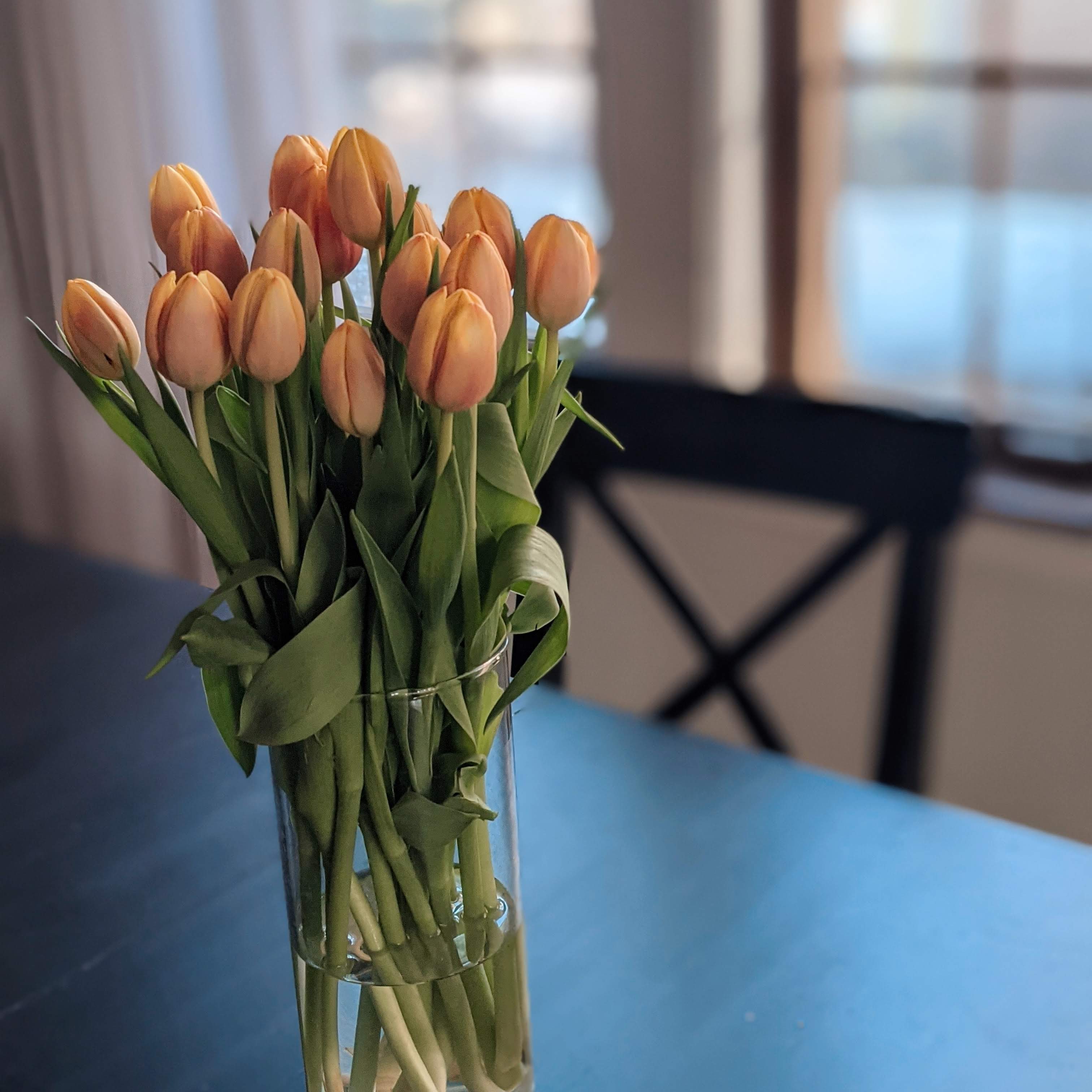
tulips

Be gentle
with yourself.
Listen closely
to your heart
to the robins’ chirping
to neighbors, far and near.
Speak slowly,
and with intention.

Breathe in the aching beauty
of this strange world — open
restaurants, churches, playgrounds,
children’s laughter sailing in the breeze,
your son hugging his grandparents,
exhaling without fear of harming them.

(You can cry — it’s healthy to cry.)

Unmask your trauma:
name each wound, each loss,
and cradle it close
apply the salve of time
and progress. Remember healing
is rarely linear, rather, it unfolds
mysteriously.

Make plans but hold them loosely.
Let time stretch out before you like
a rolling wave. Savor it.

Stay humble,
and cultivate kindness.
Keep disrupting hate
in all its ugly manifestations
search your heart
call it out
call your reps
send a call up to your Creator.

Keep tending to simple pleasures —
yellow tulips on your table,
mint chip in a sugar cone
from the corner creamery,
a lazy morning snuggling in bed with them,
new library books to devour —
relish their sweetness.

Move at your pace;
don’t let the rush
of hustle lure you
into the race again.

The truth? There is no race.
But there is one sun
around which we all orbit
searching for meaning
and love, and
aren’t you glad you made it this far?
Can you feel the thrill of spring rising?

Dare to dream again
make it bold
make it juicy
make it lavish with hope.
This is your
“one wild and precious life”
said the poet.
Now what will you do with it?


// inspired by Louise Erdrich’s “Advice to myself”; final quotation from Mary Oliver.