In my early twenties, I lived for running. In college, I jogged through campus and ran the backs of Cambridge while abroad. After graduating I ran 5ks, then half marathons and even triathlons. For three seasons, I was a girls running coach. I frequently ran the Chicago lakefront.
Then I stopped.
I stopped running consistently because I got pregnant with my son, and my morning sickness was horrible. I stopped calling myself a runner because I wasn’t—and even after I gave birth and was cleared to workout I only ran in fits and starts. Pregnancy was hard on my body; I wasn’t ready.
Now, as summer turns to autumn, I’m finding I’m craving running more than ever before. It was a hard summer, I’m ready to let go of all that’s passed and embrace the change in season. I’m ready for crisp, cool mornings and cozy sweaters, shorter days and longer nights, warm meals and pumpkin spice everything. And I’m ready to run.
Movement—whether running or yoga or other forms of exercise—has always kept me grounded. Returning to running has been like reconnecting with an old friend: my feet bound along the path, my heart warms, breath quickens, eyes open wide. As I run, I drink in the exquisite beauty of the world around me. This is why I love running. It makes me come alive.
Autumn has landed. Change is coming. What do you need to let go of? What do you need to hold onto or rediscover to stay grounded amid transition?
Lately it feels like everything is scrambling for my attention. Unread emails. Missed text messages. Facebook notifications. Shows to watch. Articles to read. New podcasts to play. The pull of infinite content, waiting to be consumed.
Do you feel it too?
We have work to do, bills to pay, children to raise, relationships to nourish, bodies to feed/exercise/clothe/rest. We belong to faith communities and organizations and gyms. We have second jobs and side hustles and volunteer gigs. Lunch dates, dinner dates, brunch with friends. Never stopping. Never slowing. Go. Go. Go.
Our lives are full. Our attention—limited. We feel overwhelmed.
I have this theory about attention. It’s kind of like water from a well. The well is deep and expansive, filled with cool, refreshing water we can share with others. On good days, we share water generously and have plenty left to nourish myself. Sometimes we hoard water, and we become bloated. Sometimes we waste water and only have a little left for ourselves. If we’re not careful, the well can run dry.
In this moment in time, I believe we’re all thirsty for something better. We are all parched.
So what do we do? How do we fill up our well?
First, we need to examine what true attention really is. Ever been in a really good conversation with someone where it felt as though you were really seen and heard? They allowed you to talk as much as you needed without feeling ashamed or embarrassed, nodded their head at all the right times and asked engaging questions. Didn’t that just make you feel warm, cozy and joyful?
My late grandpa was a lot like that–an attentive, compassionate listener. If he engaged you in conversation–and chances are certain that if you looked like you needed company he would–he’d give you his undivided attention, nodding his head and asking questions.
My grandma told me recently that often when new members of their congregation, Christ the King Lutheran Church, were asked why they joined, most had the same answer. (No, it wasn’t Jesus.) They said they came because of Richard (my grandpa). Imagine that!
I think one of the joys of my grandpa’s life was learning about others and encouraging them. He was warm, kind and generous to everyone he met.
There are a lot of things to pay attention to these days–but certainly paying attention to people seems like a good place to start.
Whatever it is that clamors for your attention, consider this: Paying attention is an act of love.
That’s what the award-winning film Lady Bird asserts in this exchange between Christine (Lady Bird), a senior at a Catholic high school, and her teacher, Sister Sarah Joan:
Sister Sarah Joan: You clearly love Sacramento.
Christine ‘Lady Bird’ McPherson: I do?
Sister Sarah Joan: You write about Sacramento so affectionately and with such care.
Christine ‘Lady Bird’ McPherson: I was just describing it.
Sister Sarah Joan: Well it comes across as love.
Christine ‘Lady Bird’ McPherson: Sure, I guess I pay attention.
Sister Sarah Joan: Don’t you think maybe they are the same thing? Love and attention?
Amen, sister!
This scene is wedged within tense moments between Lady Bird and her mother, who relentlessly criticizes her. We see her mother’s behavior throughout the film and notice it is a demonstration–though a harmful one–of her deep love for her only daughter. That difficult relationship comes to a head when Lady Bird’s mother finds out her daughter applied to and was accepted accepted into a college outside of Sacramento she was forbidden to attend. As punishment her mother stops talking with Lady Bird and ignores her completely.
Lady Bird’s mother vengefully rescinds her attention, her love, from her daughter and gives her the silent treatment. It is painful for Lady Bird and painful to watch.
An aside: Ever given someone the silent treatment? Ironically, this ‘punishment’ takes an incredible amount of attention to pull off–and for Lady Bird’s mother to do so for a long time indicates the depth of her disappointment and love for her daughter.
Although we never see Lady Bird and her mother reconcile, there is a moment at the end of the film when Lady Bird calls her mother and pours out her heart to her over voicemail, making me hopeful that they someday will.
I wholeheartedly agree with the writers of Lady Bird: attention is an expression of love. And I’ll add–sometimes, attention is holy.
Ever have a heart-to-heart with someone that leaves you feeling relieved and understood? Ever lock eyes with someone and feel like they saw your soul? Ever receive public or private praise for something you worked hard on—even when you thought no one was noticing? This is holy attention. This is love in action, life-giving and nourishing and focused and pure.
I have a hypothesis about our current technology-ridden context. What if we are all feeling so exhausted and scattered because we’re not being intentional with our attention? What if we’re not using it wisely?
How many of us struggle with the dance of dividing our attention, knowing we have, on occasion, failed in our relationships or commitments or even our self-care simply because we feel as though there isn’t enough time?
Here’s the hard truth: Our attention has limits.
We’re only human after all.
If I do a time audit of my day, what might I find about my attention? I think I would be surprised to find the amount of attention I waste on social media–on my phone–rather than noticing the world around me. I want to spend more time cultivating relationships, including the most important relationships–with God and family and myself.
So how do we start living in away that honors what we really love?
We remember attention is holy.
We understand attention is a gift.
But here’s the secret: there is a way to deepen your reserves of attention. And that means giving that holy attention right back to yourself. Nourishing yourself with water from your well.
Listening to the voice inside of you that declares: THIS is what makes me happy. THIS is what I really want and need to do today.
I have this nagging pain, can you heal it?
I have this burning desire to dance, will you let me?
I am feeling stuck, can you help me get unstuck?
Will you pay attention?
Here is a new definition of self-love for you. It’s not getting a pedicure, taking a bubble bath or winding down with a glass of wine–though any of those things are justifiably nice. Self-love is paying attention to the voice inside you that is wild and free, and really listening to it, and seeking to align your actions with your innermost healthy desires.
When we give ourselves the kind of holy attention we crave from others, imitating the kind of holy attention only God can give us–pure, adoring love–it is easier for us to then share our attention with others.
I think about the way, as a mother and on my good days, I give holy attention to my son. How can I give more of that away to people who matter (and less to social media, to my worries)—including me? How can I spend holy time and attention immersed in prayer?
Notice–without judgment–where you spend your time this week. How can you redirect it so that you are giving holy attention to yourself–and to everyone and thing that matters most to you?
Know what I realized lately? So much of the creative process (and life) is about getting out of your head and following your heart.
Noticing your inner critic—who says you can’t make anything original/you’re not talented/you don’t have a story to tell/you can’t finish that project/etc.—and flipping her script. Talking back, then moving ahead.
Wanna try it?
Repeat after me: I am original, creative and talented. I have a story to tell. I have something to say.
Be your own cheerleader. It’s that simple.
It’s time for some spring cleaning: Let go of the clutter and negative noise crowding up your head space. Replace it with something powerful and beautiful instead.
The world has enough angry voices shouting for our attention. How can you give yourself a little more love today?
It happened on a Tuesday morning. I stepped on the scale and it there it was, the number I’d been longing for—my pre-baby weight. Seven months had passed and finally all 50 (yes, 50…) pounds I’d gained via pregnancy were gone.
This moment I’d built up in my head, this goal achieved felt strangely anticlimactic.
Despite all my work to “bounce back,” deep down I knew the truth, and the truth is this: my body will never be the same again. Since giving birth the skin on my stomach is a little stretchier, my butt’s a little saggier, my laugh lines are a little deeper. My hair is perpetually shedding. My hands are starting to look like the way I remember my mother’s hands looked when I was a child, etched with extra lines and wrinkles.
My body will never be the same again.
As a new mama I’ve made peace with this fact, though it’s taken me some time. When I first got pregnant, I didn’t fully comprehend the physical and mental transformation I was about to undergo. There’s a lot that has been said about how becoming a mother changes your sense of identity, but I think that the natural, slow progression of women’s bodies postpartum is not talked about enough.
What the media tells us about mothers’ bodies
In the U.S., the media and our culture celebrate the beauty of the glowing, expectant mother. There is nothing inherently wrong about this.
Here’s the rub: The messages a mother hears change quickly after she has given birth. She is exhausted, hormonal and experiencing a seismic life transition and what does the media say a new mother should focus on?
Well, for starters, her baby, but also her “post-baby body.”
Really?
Yes, really. Women—especially celebrities—are expected to drop all the healthy weight they gained as part of pregnancy ever-so-quickly, practically the moment their baby’s out of the womb.
Almost as soon as Beyoncé had her twins, entertainment sites were covering her weight and shape. (See: this, this and this.)
All women face this obstacle
We ordinary women feel the pressure, too. After I had my son, I felt unnecessarily anxious about dropping the extra padding I still carried, even though I knew holding onto this weight was completely natural. This certainly wasn’t in the forefront of my mind what with so much else to worry about, namely, figuring out how to care for my infant son, but it was still there, lurking in the background. As I recovered from my C-section and struggled to make sense of the trauma of Jack’s birth, I was troubled by the worry that my body would stay “big.”
I know I’m not alone in this.
Mamas, I wish we could give ourselves some grace about our postpartum bodies, but popular culture is working against us. Whether we believe them or not, we internalize messages we receive from the media we consume that promote the archaic lie that a woman’s worth is measured by how small she is. (Being pregnant is the one time this “rule” is suspended but even pregnant women have body image issues and wish their pregnant bodies looked a certain way. I’m working on a future post on this too–stay tuned.)
As media companies embrace more body-positive messaging, I see the tide turning, but overall we in the U.S. continue to be obsessed with judging women for their bodies. The thinner, the smaller, the better.
Health and fitness companies prey on postpartum women’s insecurities, encouraging new moms to buy their [protein shake/workout program/coaching service] NOW to get their pre-baby body back.
What the media and health/fitness industry fail to mention is that this set of expectations is not healthy or normal. This pressure to get back to normal (whatever that is) is harmful and quite frankly, offensive.
The early days and weeks post-birth are an incredibly tender and trying time physically and emotionally. Your body is healing and yet it’s also being tested with the demands of caring for an infant. That’s enough in and of itself. If you haven’t lived it, it might be hard to understand but trust me: that’s enough. Just live and let your body heal.
Yes, I know this is easier said than done. A wise friend once told me that it takes a woman’s body 40 weeks (give or take a few) to transform and bring life into the world, so she should allow herself that time or more to recover. This advice was a great comfort to me as I struggled with my postpartum body.
My journey
I titled this article “Making peace with my post-baby body” — how did I do that?
First, I managed my expectations from the start of my pregnancy. I knew from the mamas in my tribe and from books and articles that pregnancy and birth would change my body–for good. I also knew that breastfeeding would help me lose some weight naturally, over time.
It’s one thing to know this, but it’s another to live it.
Early on after I gave birth to my son I hit a weight loss plateau for a few weeks. The number on the scale wasn’t dropping the way I thought it should. During this time I worried I had some sort of thyroid issue, that my body would stay this way forever. I realized in my worrying I was being ridiculous and I had other, more important things to worry about (i.e., taking care of our son), but I still worried.
I kept breastfeeding, drinking water and eating healthy meals when I could.
At six weeks postpartum, I was cleared by my doctor to start working out again. I joined my local yoga studio and started going to classes here and there while my son was napping.
I remember the first time I got on my mat after having Jack. I barely recognized my body in the mirror. My body was lumpy and weak. I felt a bit like I didn’t belong.
But by the end of class, I felt transformed.
I felt calm, powerful and refreshed. My body remembered yoga and it craved more of it.
Going forward, whenever I could find a free hour away from baby, usually 2 to 3 times a week, I’d go to my studio. Practicing yoga made me feel more confident and grounded.
Early on one of my instructors began class by talking about intention on and off the mat. “What is your intention for this class, this season of life?” she asked.
In that moment I realized that my intention would need to be patience. I would need to trust that my body would heal the way it was meant to, slowly and over time. I needed to stop stressing that my body even defined me–what defined me was my character, my roles as a mother, wife, daughter, sister and child of God.
Buoyed by my intention of patience and the truth that our bodies do not determine our self-worth, I began my journey toward body peace and acceptance.
And wouldn’t you know, slowly the weight began to come off. However there are ways my body has changed that are permanent, and I know once I stop breastfeeding I’ll go through another whole set of changes. I have simply acknowledged these changes, then acknowledged that they have nothing to do with WHO I am as a person.
Maybe that’s why the number I recently reached on the scale isn’t so important anymore.
I’m making healthy choices, but I also have a healthier mindset towards my body. It was my journey over the last 6-7 months toward self-acceptance during which I cultivated a deep peace and comfort with change.
Now that’s something worth celebrating.
—
Have you ever felt insecure in your own skin? What helped you cope?
The studio is quiet, hot and dimly lit. Walking on tiptoes, I locate what seems to be one of the last open plots of space and unfurl my teal-colored mat to claim it. The flip of the mat hitting the ground feels weighty, and loud. I look around but no one else has noticed. I take a seat.
This my first *hot* yoga class since I became pregnant. I am six-weeks postpartum and my body still aches from labor and lack of sleep.
At home, my husband is watching our newborn son. I am here, at this class, for some much-needed me-time.
At least my body is here. My mind seems to be elsewhere.
A thousand different thoughts crowd my mind: I worry I will not make it through the heated class. I worry about how my postpartum body looks in the studio mirror, new curves and extra padding. I worry about what my son is doing right now. Is he sleeping? Is he eating? Is he OK?
I am anxious and impatient for class to begin, and, just when I feel I can’t wait any longer, the teacher comes in and instructs us to begin to “settle into your space.”
Settling in is the last thing I want to do right now. I want to shut off my mind and move. I am in the middle of a major life upheaval and I’m still figuring out how to cope.
Looking back, my life before baby seemed so calm, so simple. Weeks were punctuated by work, workouts, nights out with friends.
Now life’s a whirlwind of feedings, playtime, napping, diaper changes; it’s enduring sleepless nights and thankless chores; it’s . . . complicated.
And it’s also incredible. As a new parent, every moment of the day is amplified by my little one’s existence. The pure joy and love I have for my son is bigger than anything I’ve ever felt before.
Class is starting now and I try to focus in on my breath, on the gentle instructions our teacher provides. We begin to flow from tadasana (mountain pose) to uttanasana (forward fold) to ardha uttanasana (halfway lift), and I feel a sense of release as I move through these familiar motions.
My heartbeat pounds, my limbs lengthen, the chatter in my mind goes mute. I’m keyed into the sequence now, and my muscle memory takes over as I swoop from urdhva mukha svanasana (upward facing dog) to adho mukha svanasana (downward facing dog).
As we progress, poses that once felt easy are hard. I push through, acutely aware of each sweaty minute.
I struggle as I strive to maintain composure during a particularly difficult sequence. My teacher offers modifications and I take them all with confidence. There was a time when this sequence would have been easy for me, but now it is not. I surrender to what my body needs today, resisting the urge to work too hard too soon.
When the instructor finally invites us to enter savasana (corpse pose) I collapse on my mat with a smile, knowing at least I’ve nailed this last pose of renewal and relaxation.
My body feels heavy, glued to the ground. I am tired AND energized AND already ready to come back again.
In the six weeks that I was recovering from giving birth, I missed the simplicity of my mat and the comfort of this routine. At a time when it seems as if everything has changed—my strength (or lack thereof), my family, my body, my mind—yoga is one constant.
As I relax in the darkness, I think about why yoga is called a “practice,” an act you master with time. It is not a performance, but a sharpening of the mind and body, a discipline that requires mental resilience and acute body awareness.
After years of practicing yoga I’d forgotten what it felt like to be a novice. Having a baby, taking a break from my mat, reminded me.
Life—like yoga—has a way of ebbing and flowing. In this season of life, I am novice parent, trying to make sense of the new complexity raising a child brings, I’m again a novice yogi, rediscovering my strength on my mat.
Coping with a BIG life transition—whether it’s a breakup, parenthood, a new job or moving—is never easy. When we make time to embrace old routines, however, they lift the burden of foreign and for a moment, ground us in the familiar.
Just sixty minutes ago, my life felt so off balance. Now I felt grounded.
We sit up and begin to seal our practice with a community breathing exercise. “Inhale to the count of three . . . now exhale deeply,” the instructor says.
I breathe in deep, I breathe out a sigh of relief.




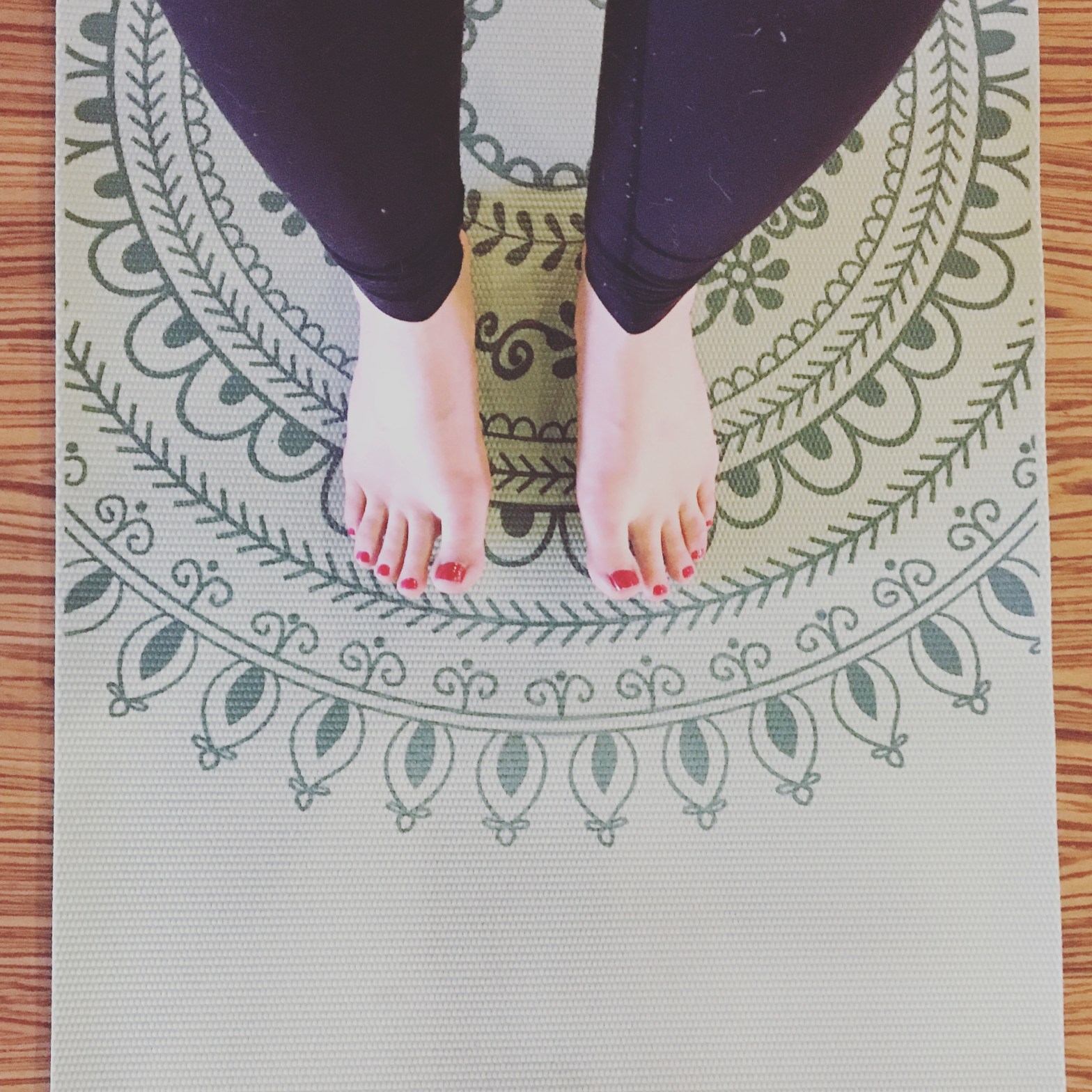
 The studio is quiet, hot and dimly lit. Walking on tiptoes, I locate what seems to be one of the last open plots of space and unfurl my teal-colored mat to claim it. The flip of the mat hitting the ground feels weighty, and loud. I look around but no one else has noticed. I take a seat.
 Erin Strybis