
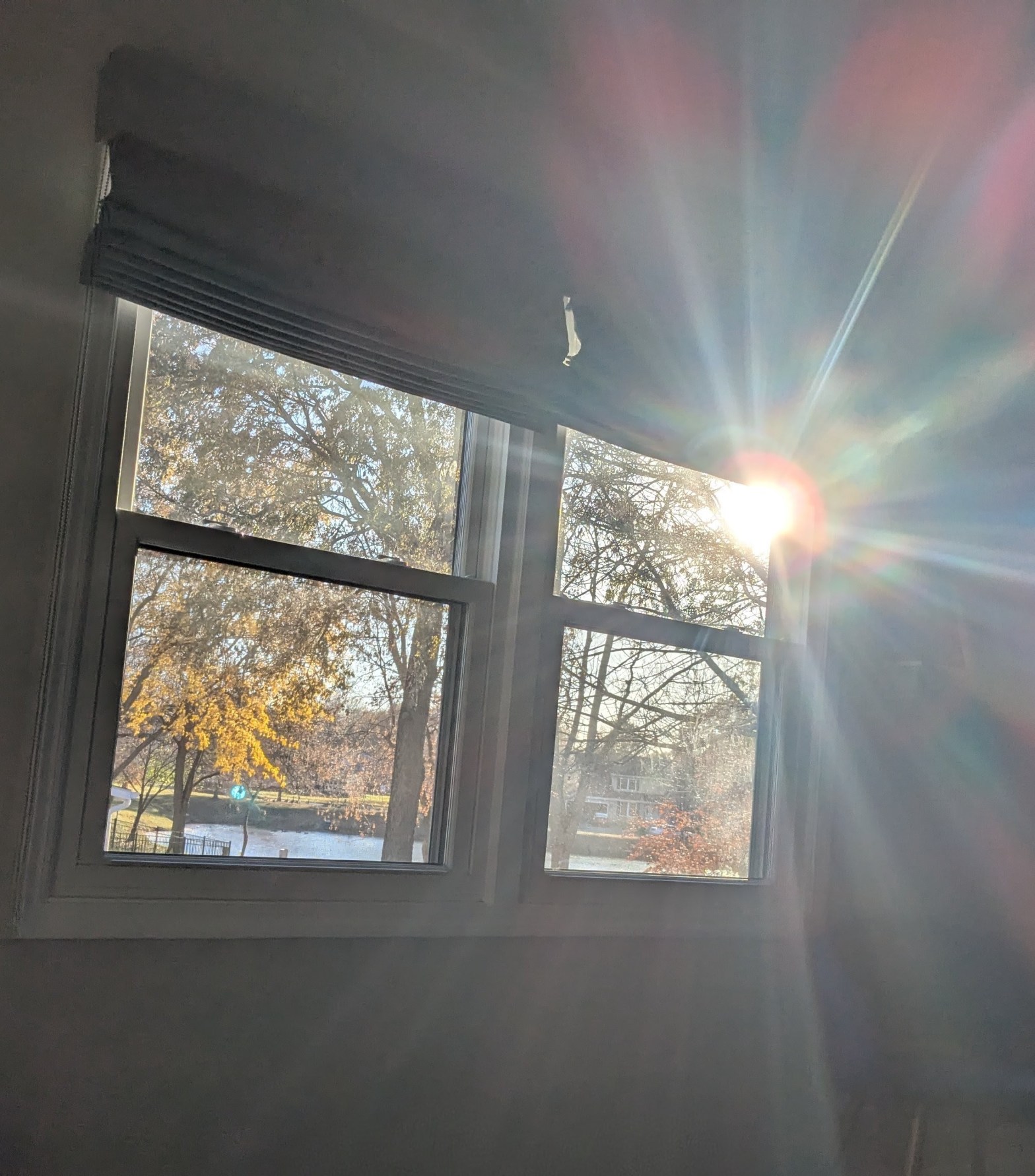
verb: to reflect or release light
noun: radiance; the brightness caused
by a bounce or outpouring of light
My verbs are:
Reading Frog & Toad, Hilo and The Jesus Storybook Bible
Bringing my boys to church
Giggling together on family movie night
Writing between school dropoff and pickup
Throwing a baseball over and over
Lingering outside until sunset
My nouns are:
Buttered toast and apple juice
Hot pepperoni pizza and fizzy root beer
Magna-Tiles and Legos strewn over the carpet
Bright smiles for “One more race!” in Mario Kart
Handwritten drafts, Google docs and Substack
Prayers for goodness and forgiveness
My confessions:
I do not know how to reconcile
my small life raising small people
with my big dreams of writing.
Am I teaching them to be kind?
Do they know how much I love them?
Or see how hard I’m trying?
Will I ever publish another book?
For every struggle
and every joy,
every sacrifice
and every lesson —
there’s no grade.
Oftentimes, I want one.
God, do you see me?
Am I doing enough
to reflect your grace and your glory?
Here is the better question:
Can I trust you enough to release
my grip on my plans and my ambitions?
// Callie Feyen’s poem “Witness,” from her new book When We Swung from Church Bells, inspired this poem’s structure. “Shine” is my word of the year for 2026.
Category Archives: writing
Bold, bright and brave: a birthday tribute
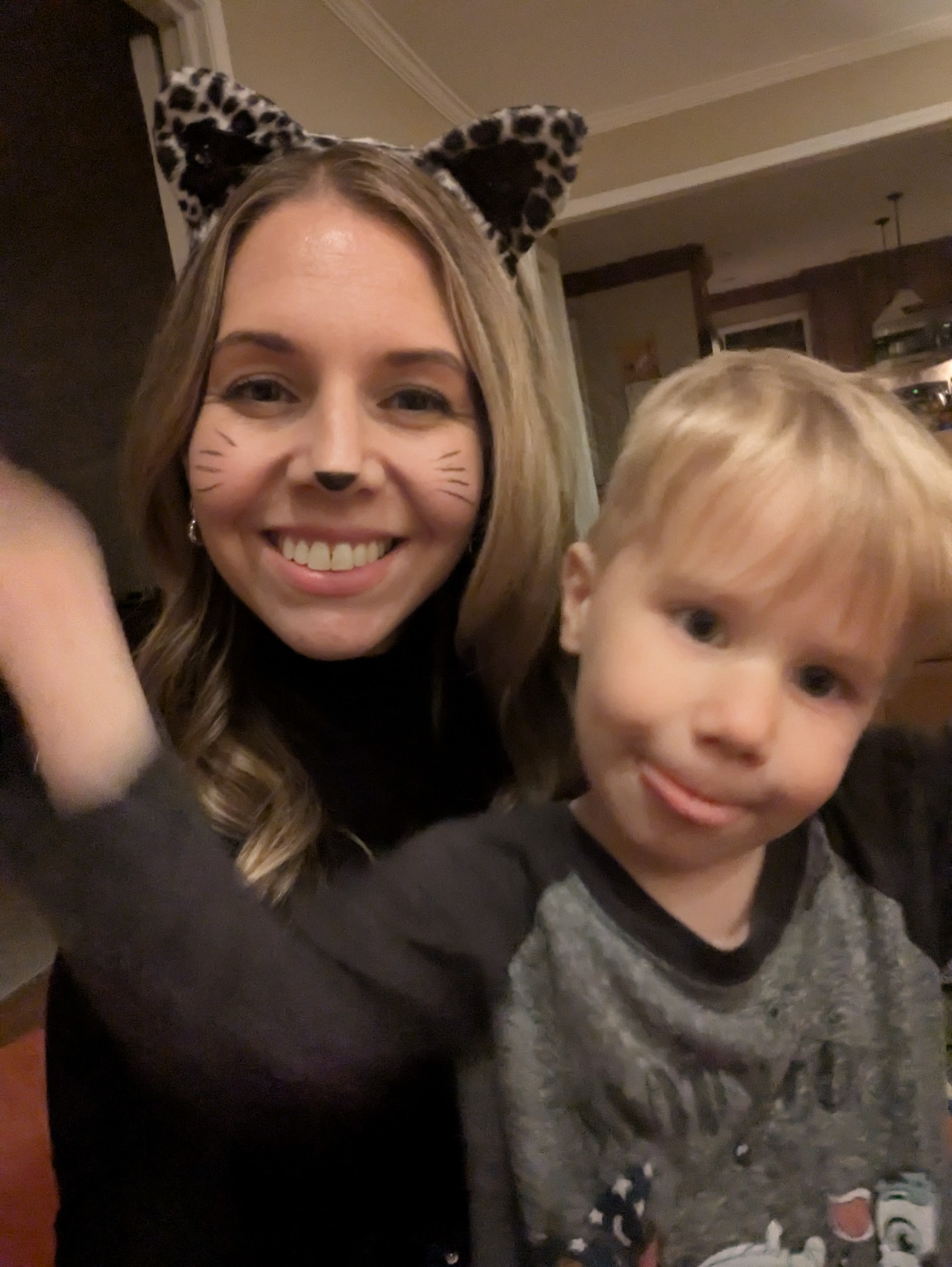
As a baby, you stuck to me like glue, nursing ‘round the clock and snoozing on my chest. Throughout your first year, we broke all the “sleep rules” with you, and we didn’t care. You were our long-awaited second child, our rainbow baby after miscarriage, and our last child, given my age. Your dad and I were going to savor you.
Adam, you arrived five years and two days after your brother Jack was born, and you haven’t stopped chasing him since. Milestone after milestone, you’d leap frog past our expectations, determined to be just like Jack.
No one told me that younger siblings tend to age faster than their older siblings, and the ache to keep you little is one I’ve felt acutely in your third year. You started preschool this past fall, and each week, you share new revelations with me — singing songs, scribbling your name and chatting about your new pals. After we get home from school, you want to sit on my lap when we eat lunch together; you like a peanut butter and jelly sandwich or chicken nuggets and cucumbers.
You also like free building with Legos or Magna-tiles, playing your brother’s Switch, playing with and/or annoying your brother and drinking root beer as a special treat. You are bold, bright and brave, barreling into new experiences and connecting with new playmates. “Watch me, Mom!” is a common refrain. Your zest for life inspires me.
You’re my little buddy, helping load laundry and wipe the kitchen table clean. You accompany me to the library, Trader Joe’s and Target often. Sometimes, we’ll do coffee and pastry dates. And when it’s warm enough, we’ll walk our dog to the playground and play pirates there.
Even though you’re so big, you still like to be close to me when you sleep. After storytime and lights out, I’ll snuggle next to you in your bed for five minutes. When I say, “It’s time for me to get ready for bed,” you protest, begging for “One more minute!” repeatedly. Finally, I say goodnight, and you hold my face in your hands and kiss me on the forehead with relish, an echo of how I kissed your forehead as a babe.
Happy fourth birthday, Adam. It’s a gift to love and be loved by you.
Reaching for goodness
“A writer will be interested in what we don’t understand rather than what we do.” —Flannery O’ Connor
Your oldest son asks what you and his dad are whispering about before dinner. Facing a cutting board strewn with tomato juice, you startle as if you’ve been caught passing notes in class. He cocks his head, waiting.
“Dad and I were discussing gun violence… again” would be the honest answer. You glance at your husband. “Don’t worry about it, honey,” is what you say instead, picking up the knife and slicing more tomatoes. Which is ironic, considering the fact that you are indeed worrying — about school shootings, political violence, the genocide in Gaza, wars abroad and division in your country.
Your son doesn’t like your answer, but he’s already moved on, curious about what you’re cooking for dinner. Tacos, you answer. It’s taco Tuesday, after all, and the absurdity of making pico de gallo while grappling with death makes your stomach churn.
At church, your pastors preach that God is good and people are sinful, and while you agree, you also wonder about this message’s effect on the human psyche week after week. And what of the barrage of bad news we receive, almost daily, on our screens? How does that affect one’s heart?
At the start of the creation story, God makes humans in God’s own image and calls them very good. Sinfulness writes headlines, but what about our innate capacity for goodness?
You think of the way your youngest wraps his arms around your back and hugs you hard like he’ll never let go. You think of your oldest, and the stories he tells you before he drifts off to sleep at night, how he loves to have you listen. Yes, your kids fight and whine — all kids do — but oh, what a marvel they are, what a gift of creation.
The next day, when your beautiful children are at school, you sit at a library desk and press your pen to the page. You wonder, why bother writing at all when there’s so much brokenness around us? What good will my words do, anyhow? Why write?
You look up, eyes settling on elegant shelves brimming with books. When you were young, you reveled in storytime with your parents. After you could read on your own, you carried books with you the way you used to carry around your favorite flower blanket. Since childhood, stories have been your compass, a means to navigate a confusing world. You write because you first read.
As a freelance writer, you create work no one wants to pay for, but everyone needs. Articles, essays and devotions guide our thinking. Poems, prayers and stories comfort us at weddings and funerals, birthdays and graduations. Writing often garners measly (if any) wages and is already being replaced by AI. You write because the need to express is human, and our stories are marked by emotions, memories and hard-earned insights no computer can ever comprehend. Human storytellers have had a place in society for eons and they will continue to be vital. Life begets art; art begets life. You claim the title storyteller.
You write because once, an author wrote something that touched the deepest part of you, and you finally felt known and less messy and truly worthy and you want to try and do the same thing for someone else. You fold your memories and reflections with care and fashion them into an origami crane. You place the crane into a reader’s hands and say, “Here. I made this for you, I hope it makes you feel less alone. I hope it makes you feel something.”
You write because holding a pen in your hand is akin to stepping on an express train. It’s as if God handed you a ticket and murmured, Enjoy the ride. You write because the journey beckons.
You write because filling a blank page with ideas empties you like nothing else can. Writing is hard work for a busy mind like yours. You aren’t the kind of writer who can produce graceful material upon first draft. If anything, your drafts are a lot like your garden — in need of weeding, watering and time in the sun. In other words: wild.
Maybe revision is part of the appeal? You spent many years as an editor, clearing space for others’ stories to ripen. After tending wild words, you feel wrought out, clear, purposeful, powerful.
True, you might toil for hours unseen on one paragraph that will be read by two people and cause seven to unfollow you. Nevertheless, you nurture stories for the few who pause to appreciate their beauty — and will then be moved to grow and bloom themselves.
And it’s this beauty that guides you today, as you sort through memories from recent days, searching for evidence of God’s grace among us.
You write to reach for goodness.
How else would you remember a cool breeze rippling through your sweater on a September morning, your first sighting of crimson leaves, foreshadowing the approaching autumn? How else would you remember tossing the football with your eight-year-old son, both of you barefoot in the yard, amber light filtering through the trees, and the glowy feeling inside when he asked you to play with him? (You feel lucky he still asks.) Who else will account for your preschooler’s make believe, and the cookies and fruit he served you in the play kitchen? You write because you love your family, and you love God’s world and this act of documenting what you love is a prayer of thanksgiving.
You write because you can’t imagine not writing. Your hand gets itchy if you aren’t able to write for too many days. Because there is a story waiting to be written that only you can tell. Because readers are waiting to be known by your words. Because you were created to create. Because, in spite of everything, you believe in humans’ capacity for goodness. Everyone is starving for kindness and you will do your small part to serve up hope.
What’s saving my life right now (or, some things that make this winter easier):

{water} On Valentine’s Day, a pipe broke in our suburb causing our apartment complex and many other homes and businesses to lose access to clean water and plumbing.
This is embarrassing, but in my 39 years, I’ve rarely considered my dependence on water. It’s always been available. After using bottled water to brush teeth, wash hands, cook and more, plus coping with toilets that didn’t flush, I felt painfully aware of those privileges.
Cleaning up a particularly messy potty training incident without water made me crack. “That’s it, everyone,” I announced, surveying the damage. “I can’t take this anymore. I’m calling Grandma.” The kids cheered. Jay and I packed up our things and fled to my parents’ place in Chicago’s western suburbs to wait out the issue.
Meanwhile, an area hospital had to rely on bottled water and brought in temporary sinks to serve its patients. Other residents and businesses found ways to survive without running water. Everyone was humbled by this hurdle.
Two days later, the pipe was fixed and water was restored. Jay and I returned home to run faucets, clean toilets, change filters and empty out the icebox. We caught up on chores and laundry and, in the midst of our housework, we counted our blessings. Standing under my apartment showerhead, feeling hot, clean water rush over my shoulders, I practically cooed. The expression is true: Water is life.

{electric blanket} Each Christmas, my mother-in-law’s extended family hosts a white elephant gift exchange, and through a shrewd trade for a Hello Kitty mini fridge, we acquired an electric blanket. Though I’d never thought to buy one myself, this product is one I never knew I needed and this winter, I can’t live without. My oldest fights me for it, but the biggest fan of the electric blanket, other than yours truly, is our pug, Gus, who at nine-years-old is becoming more and more like a cranky old man. Whether I’m warming my shoulders at my desk or snuggling underneath my electric blanket while watching TV, Gus is nearby, mooching valuable blanket real estate. I don’t mind sharing with him.
{screen boundaries} Recently, Jay and I banned our oldest from using his iPad on weekdays. Weekend use was fine, for an allotted time. But we were done with weekdays. “You guys are no fun,” Jack huffed. “Why are you doing this?”
I could see one of his iPad games having an addictive effect on him because I’d felt that same pull myself, but with checking Instagram and Facebook. This past January, I fasted from social media for a month. I’ve done this before, often in the summer. Though I missed connecting with my friends there, what surprised me most about this fast was how free I felt without these social platforms, which are designed to be addictive. My mind felt clearer, and I wanted that for Jack.
“Too much time playing [addictive game redacted] isn’t great for your brain, the same way too much time on Instagram isn’t great for mine,” I told him.
Did this go over well? Absolutely not. Nevertheless, he’s accepted our new boundary and it’s helped his mood stabilize. Meanwhile, I’m dipping my toes back into social media, trying to find a boundary that works for me. For now, I’ll try Fridays only to connect with friends and share stories and photos. I hope our new boundaries will disrupt the addictive nature of our screens while allowing some room for fun.

{notebooks everywhere} Though I write a lot on my phone and computer, my preferred method remains by hand. Writing guru Natalie Goldberg instilled in me the virtues of writing by hand as a means to free one’s inner thoughts and it’s my go-to practice for early drafts and late revisions. Something about moving my hand helps quiet my inner critic (after many years working as a magazine editor, this is crucial to my process as a writer). So how do you write by hand when you’re a busy mom on the go? Stash notebooks everywhere. I have one in my car, one in the kitchen, one on my desk and one on my nightstand. Each is filled with journal entries, stories and lists. “Keep your hand moving,” Goldberg instructs in her book, The True Secret of Writing. “If you say you will write for ten minutes, twenty, an hour, keep your hand going. Not frantically, clutching the pen. But don’t stop. This is your chance to break through to the wild mind, to the way you really think, see, and feel, rather than how you think you should think, see, and feel.” There’s just something about writing by hand. A multitude of notebooks makes it possible.
{the children’s museum} After we moved to the suburbs, I left behind our beloved neighborhood filled with friends we’d known for years for a brand new place where we knew absolutely no one. Though we lost proximity to friends, what we gained was closer access to the local children’s museum. After I sprung for the annual pass, my youngest and I found ourselves there often, reveling in pretend play. When we visit, Adam fixes sandwiches at a restaurant, changes tires at an auto shop, paints a house, drives a train and more. It’s where we celebrated his third birthday, and where we meet up with his buddy from our old neighborhood. This is Adam’s happy place and I’m here for it.
{redwoods} Real talk: this winter, I’ve been moving through the anniversary of a traumatic experience. Some days are steady and even hopeful. Others are shaky and especially tender.
One thing that helped?
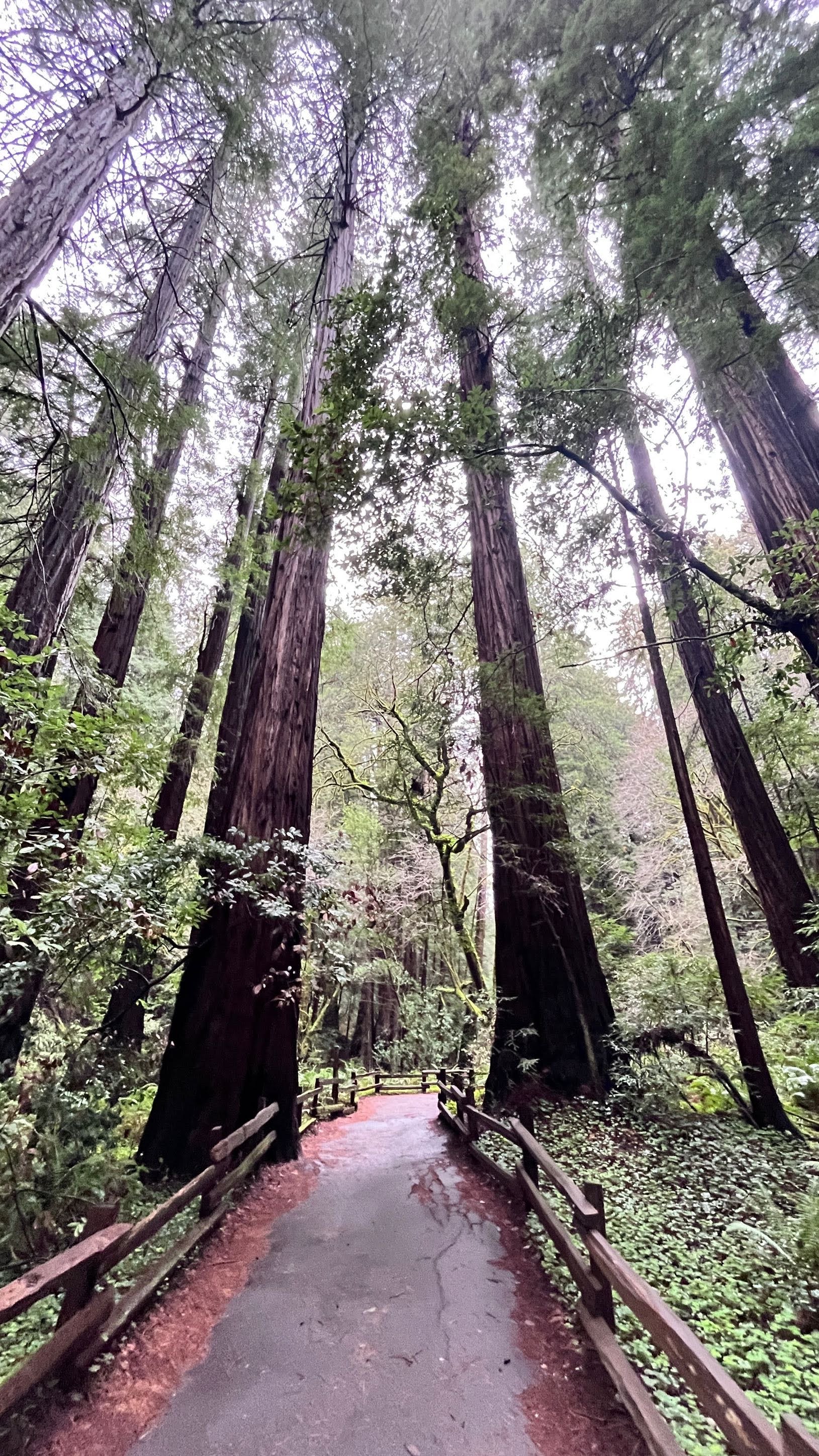
In early February, I traveled to San Francisco to spend time with my writing group. Fay, who lives in the Bay area, hosted. As part of our retreat, she drove us to Muir Woods, home of the ancient coast redwoods. I read in my brochure that redwoods have been in California for 150 million years, and those at Muir Woods are between 500 to 800 years old.
Entering the woods was like gaining access to a secret garden.
Redwoods soared high. Emerald moss decked their reddish brown branches. Spring green ferns burst from the forest floor. Cool mist hovered around the woods, as if we were stepping inside a cloud.
Fay, who has faced much adversity in the past year, paused on the path and gazed up at the towering trees.
“You know, sometimes when I get discouraged by the news or my life, I think, whatever is happening out there, these redwoods have withstood it for hundreds of years, and they’ll still be standing afterwards,” she said.
Spellbound, I nodded. Though we’d talked nonstop until this point, I’d run out of words. My brave and generous friend couldn’t have known how much her words meant to me. Here in this tree cathedral, I felt as if I’d received communion. I had a renewed sense that what had transpired last winter would not define me. Remember this moment, I thought. Remember her.
I have thought of Fay’s wisdom a dozen times since we visited Muir Woods with our friends. The redwoods are still standing. We are, too.
// I wrote this post in collaboration with my writing group. To read more “What’s saving my life” lists, visit Kim’s post, Melissa’s post and Fay’s post.
M A K E

verb; noun
To bring into being / Create / Compose / Shape
As in,
my friend Donna conjures
harmony from thin air:
she hears
a melody, she summons
notes and voices sweetness
like a magician blooming
roses from her wand.
She says, “It’s nothing!”
I say, “It’s a spiritual gift!”
— and we’re both right —
For, isn’t the ability to fashion
beauty from nothing endowed
to us by the Master Artist?
As in,
Merriam Webster offers
25 definitions for the verb “make”
and that doesn’t include all the idioms:
make waves, make up your mind, make light
Something about making is essential to
our humanity
We make believe
We make amends
We make art
We make homes
We make love
We make a difference
I am trying to make
the most of the time I have left
I only know that when I bring art to life
I come alive as well.
As in,
lately I’ve been struggling
to write
I’m tired of these blase winter days
when the wind howls
and bites like a feral dog
I want to be wild like the wind —
soft, too
I want my stories to rattle you awake
and blanket the earth with snow
I want my words to swirl and linger,
to thaw an icy heart —
even mine.
As in,
my husband skitters
his hands across the keyboard and creates
a code that will animate a robot,
our toddler Adam stands at the easel, proud
he’s “writing his name” with a dry erase marker,
our son Jack sits nearby, head bent, dreaming
up new Pokemon, dazzling
the page with drawings and color,
Others bake bread and cook,
Others stitch blankets and clothes,
Others protest and revise law,
Me? I rinse dishes and soothe owies,
sing lullabies, draw baths, compose
a line in my head: Mothering is inherently creative.
As in,
at my first voice lesson,
my teacher tells me he’s heard
too many sad stories of people
who stopped singing because someone said
they didn’t like their voice,
I try to remember this, too, when I write
I became an author
because thirty years ago
someone said, “I like your voice.”
What matters more now: That I like it too.
Isn’t all art forged in courage?
Isn’t all art a window,
an offering?
How many more books or songs
have yet to be born?
Defining word: Voice
(noun) sound humans create by speaking or singing
(verb) to express one’s opinion
1. In the final stretch of our drive home from Michigan, Adam won’t stop crying.
It’s Christmas break 2022. The Chicago skyline looms ahead like a long-awaited hug. So do fluorescent red brake lights, which means we’re facing an hour of bumper-to-bumper traffic. At 10 months, Adam’s typically laid back and smiley. Today he scrunches up his face and through his wails, says he’s D O N E being stuck in the car, and honestly, I am, too. We’re in gridlock with no means of stopping and I don’t know how to soothe my baby.
“Can’t you do something?” my husband says, twisting his head back to glance at Adam. “He’s really upset, Erin.”
Adam lets out another loud wail. The sound of “Jingle Bells” filters through our car radio and I shake my head at the irony. This car ride is anything but fun.
A memory materializes: Every December while I was in high school, I’d go caroling with our school’s madrigal ensemble. Back then, bringing joy to others through song was the highlight of my Christmas season. I wonder if I can conjure a little cheer now.
“Jingle bells, jingle bells, jingle all the way,” I sing softly, squeezing Adam’s hand. “Oh what fun it is to ride in a one horse open sleigh!”
At the sound of my voice, he quiets. Two verses in, I begin to enjoy myself. I end up serenading him with Christmas carols for the rest of our trip home.
2. Each December, I select a word to guide my thoughts and actions in the new year. For 2023, I chose “voice.” Voice isn’t just the sound we make or an action we take; in writing, voice is how an author shows her personality, style and point of view on the page.
Difficult to teach and even harder to master, voice makes writing memorable. The most powerful voices leap off the page and are easy to spot when compared with the works of others. Take the writings of Brian Doyle, Ross Gay or Mary Oliver as proof. Through humor, lyricism, diction, imagery and more, each of these authors offers a distinct style for the reader to enjoy. Voice endears us to our favorite authors.
As I anticipated my book release in March 2023, voice was very much on my mind. My friend Kim and I poured our hearts into The Beauty of Motherhood, and now that it was mere months from landing readers’ hands, I couldn’t help but worry how our book might be received.
Even though I believed deeply in our book’s message, I harbored doubts about my voice. Were my devotions strong enough to stand beside those of my coauthor, whose voice I admire greatly? And how could I market this book — which I was dreading — while remaining true to myself?
I reached out to a friend and mentor for advice. She reminded me that my words intertwined with my faith, and this book was an answer to a call. She mentioned she sensed a bold strength and conviction flowing from me as I approached the final edits of this book. And she encouraged me to trust the voice I’d already developed.
3. A few weeks after caroling in the car, I’m exchanging emails with the music director of our church. I’d mentioned to the pastor in our new congregation that I used to sing, and she put me in touch with him. We schedule an audition.
The day we meet, I laugh and tell him that, though I used to sing a lot when I was younger, I’m a little rusty now. That’s not entirely true: every day, I sing to my youngest. On a dreary day, I sing him, “Rain, Rain Go Away.” When it’s sunny, “Mr. Golden Sun.” We have songs for bath time, teeth brushing, the alphabet and more. As the daughter of a music director, music was the first love language I ever learned. I can’t help but sing to my children. But I don’t say any of this to him. I simply sing.
Soon I find myself on stage alongside my church’s praise band. The first time I perform with them, I feel as if I’m soaring. Afterwards, my cheeks hurt from smiling so much. As the weeks pass, I grow to love the “intimacy of [belonging to] a tight group of people who had come together, miraculously, for a brief period in time, for the purpose of making art.”
Making music with the praise band unlocks a hidden part of me I forgot existed. I’m no longer just a mom or even a writer, I’m a creative soul who feels most at home in the world when she’s sharing her God-given voice with others.
The more music I sing, the more voracious I become for this form of creative expression: Sure, the melody is fine but could I try the descant? Or finish my meal with tight harmony? Sampling the chorus was a delight, but could I taste a solo?
The answer to it all? Yes, yes and yes.
4. I am 16 years old. In Ms. McDonough’s Honors English class we’re finishing a unit on persuasive writing. Ms. McDonough has curly black hair, bright brown eyes and insane energy, bouncing around the classroom on her chunky heels. I adore her.
We read various examples of persuasive writing, including Dr. Martin Luther King Jr.’s “Letter from a Birmingham Jail.” As a classmate reads the letter out loud, I highlight this passage: “Injustice anywhere is a threat to justice everywhere. We are caught in an inescapable network of mutuality, tied in a single garment of destiny. Whatever affects one directly, affects all indirectly.”
Just before class ends, Ms. McDonough announces a special writing project. We’ll be writing our own persuasive essays just like Dr. King, she says, passing out the assignment. I wonder what I will write about, I think, but the ring of the bell breaks my attention.
Weeks pass and I’m back in her classroom reviewing a draft of my essay.
“Right here and here are a couple phrases you could tighten up to make your argument stronger,” she notes, pointing to her green handwriting. (She uses green pen because it doesn’t derive a negative connotation, like red.) “And I think reminding the reader of your proposed solution is a fine way to conclude your argument.”
“Thank you so much, Ms. McDonough,” I say, sitting at my desk and thumbing through her notes. I will bring this home and perfect it, then hand it in on Friday. Then, biting my lip, I add, “I really hope this works.”
My topic is related to music: Recently our music department director had announced that students would no longer be able to participate in both the top band and the top choir, citing that next semester each group would practice during the same period. This change would make it easy for students to collaborate without sacrificing their lunch hour, he explained. The plan is, by all accounts, reasonable.
Except that, I was in both the top band and the top choir, and I didn’t want to choose between them I knew several other students like me, and it didn’t seem very fair for the administration to force us to choose between groups. So for my essay I come up with an argument against the change and offer a new solution to solve the existing issue. Writing this piece feels really good. It flows out of me.
”I think your words could affect real change here,” Ms. McDonough says, straightening up. “And I’ll be happy to help see that your final paper ends up in the hands of our administration.”
“Really, Ms. McDonough?” I look up at her.
“Absolutely. That’s why I created this assignment — to show you the power of your voice.”
Ms. McDonough is right. The essay does affect change and the administration chooses my solution over that of the music department chair’s. When I learn this, I’m ecstatic.
I continue participating in the top choir and top band through my senior year of high school. However, something significant does change: Rather than “Music,” I select “English major” on my in-progress college applications.
5. When our book releases in March 2023, it’s equal parts amazing and terrifying. I am overjoyed and grateful for its positive reception. At the same time, I find myself wavering in and out of a state of existential dread. The book I’d dreamed of writing years ago is now real. But the grind and pressure connected with promoting it overwhelms me.
After our formal promotional work slows in June, I am relieved and deflated. Staring at my empty planner, I have so many questions: Do I still love writing? Am I all out of stories? I am sure of one thing — I’m burned out. So I step away from writing publicly to prioritize rest and my family.
Over the summer, I tend to my wellbeing: I become more consistent with my workouts. I savor time with my kids. I devour a seven-book fantasy series. I do some freelance writing assignments and journal. The voice of Anxiety that has haunted me much of my life but especially during book season grows quieter. My prayers become more peaceful.
6. For Halloween, I sign up to help with my church’s fall festival. There’s pumpkin carving, trunk-or-treat and a Disney sing-along. I dress up as Elsa and lead a variety of songs, including Elsa’s signature “Let It Go” and Ariel’s “Part of Your World,” the latter of which was one of my favorite songs as a child.
Growing up, I was a princess girl through and through. I loved watching Beauty and the Beast, Snow White and The LIttle Mermaid, then dressing up and performing my favorite songs for whichever family members would bear to listen.
Now, when it’s my turn to sing “Part of Your World,” a smile blooms across my lips and that familiar soaring feeling arrives. I think, if only eight-year-old Erin could see herself now. She would be so proud. It’s just a sing-along, but it means so much more to me to be here, confident and brave, using my voice to share a song I love.
Surface level, The Little Mermaid is about a girl who runs away from home and changes her appearance in pursuit of a handsome prince. But the real story, the emotional undercurrent of this movie, is about being brave enough to leave old ways of being and explore a new culture. Sure, Ariel makes mistakes along the way — sacrificing her voice for a crush — but in the end, she reclaims it.
Ultimately, The Little Mermaid is a story about losing and finding your voice. 2023 would be a year of finding my voice, I’d resolved. Yet, looking back today, I wonder if it was there all along? Perhaps I wasn’t ready to claim it.
7. What surprised me most about my word of the year was the voice I found wasn’t just my writer’s voice: it was my choral voice, too. Returning to another form of creative expression helped me cope with the swirl of conflicting emotions I habored about book launch. Through song, I was able to see that the joy of art is not in its reception, rather it’s in the making of it.
I want to keep singing. I want to keep writing stories and sharing them with others. I want to embrace the fire in my voice, and glimmers of insight on the page. I want to finish things — poems and essays and maybe another book (years from now, when Adam is older). I want to keep my pen close to the page and to my heart. I have so many words bubbling up and rising to the surface now… Can I make sense of them and make an offering? I don’t know. But I have to try.
Isn’t the task of the artist that of offering a mirror to her reader to help her see the beautiful truth before her? To say, yes, there is pain in this world, but have you also noticed the grace of wildflowers? And a baby’s tiny toes? What about a woman buying groceries for a needy stranger? Or when you hear music that moves you to tears? Isn’t it an amazing thing to be alive on this fresh day — and human?
And, if enough of us artists raise our voices — enough singers and painters and pianists and poets and sculptors and weavers and actors and composers and a plethora of others — we could form a mass choir singing for peace and prosperity. We could use our voices to calm the tide of violence that threatens to drown us. We could create a new culture grounded in kindness and human dignity. Wouldn’t that be something?
This “Defining word essay” was inspired by a selection from Amy Krouse Rosenthal’s Textbook.
Fear and courage
My son declares
“I’m not scared
of anything”
Almost 7 and still a wonder
boy whose life began with a lack of breath,
who, since he found his voice
rarely stops talking, who’s made of
sugar, steel and laughter
“That’s nice, honey,” I tell him, folding
his words and slipping
them into my back pocket
like a note I want to revisit later
Me? I’m scared of all sorts of things:
Showing up late. Wearing
the wrong outfit. Singing off-key.
Saying something off-color.
My kids getting hurt or worse — dying.
Mass shootings. War. Global warming.
Cockroaches in the house and maxing
out my credit card at Target.
Scared of success
and scared of failure.
Missed naps and moldy leftovers.
Scared of parties and public speaking.
Scared of home renovations
—but also scared of moving(?)—
literally anyone who rings our doorbell.
Tantrums at the grocery store. PTA meetings.
The cool moms at school pickup. Forgetting
a deadline. Forgetting
to return a text. Forgetting.
Scared of aging. Scared of dying.
Scared I won’t ever get to the point of this poem.
Scared of tornadoes.
Scared of blizzards.
Scared of men, when I walk alone
at night, midday or early in the morning.
Scared of running into ex-boyfriends,
that band teacher who despised me,
even scarier, my ex-best friend from high school.
Scared of weight gain. Scared of wrinkles.
Car crashes. Insomnia. Cancer.
Losing track of my kids anywhere,
especially near water.
Losing my husband, mother or father.
Scared I’ve said too much.
Scared I ate too much.
Scared of all the want inside me.
Scared how much I love my children.
Scared I’ve not been a good enough mother.
All this fear inside. Where does it come from?
What I wouldn’t give to soak up
some of wonder boy’s courage
Often I feel scared of writing
especially publishing.
Scared I’ll be judged.
Worse, no one cares.
Years of writing and I’m still scared
by all the rejection.
Then I think
of my son, and the world I want
him to inherit, a society steeped
in justice, peace and kindness.
So I keep writing,
keep chasing truth and beauty,
keep confronting my fears on the page,
emerging
braver and stronger,
keep penning hope
into a world riddled
by brokenness.
Especially when

Especially when
the sunrise catches in the bushes, sliding
across the sidewalk, gilding
every zinnia and robin in its path
another day’s on the cusp of unfurling,
and I am bursting
with possibility and hope,
Especially when
two fair-haired boys melt
their bodies against mine, sleep dusting
their eye creases, last night’s dreams curling
in the air like the steam rising off my morning coffee and though the clock tick tick ticks
and the piled dishes beckon, Creativity calls me
(and I am not one to ignore *her* messages),
Especially when
I’ve just read something positively delicious
my cup is full — no, overflowing —
and my time is scarce
the page is blank and ready to be storied
I must write. What better time to spin
beauty and truth into gold
than the present?
// a response to “Especially when,” a prompt from Callie Feyen, Kaitlin Rogers, Jenna Brack, Megan Willome and others
The Beauty of Motherhood in the world

The Beauty of Motherhood: Grace-Filled Devotions for the Early Years, which I wrote with my friend Kim Knowle-Zeller, has been out in the world for more than two months. Even now, it’s wild to type this sentence, to know our stories have been read by mamas and friends near and far.
You might have a copy of our book on your nightstand or have gifted it to friends. You may have attended a book event, prayed for us, sent encouraging messages, joined our blog tour, posted about our book on social media or reviewed The Beauty of Motherhood on Amazon and elsewhere. What’s more, you’ve been recommending this book to other mamas looking for spiritual refreshment. For all that and more, thank you!
As our initial promotions for The Beauty of Motherhood close out, I’m taking a moment to celebrate this little pink book and its big message of grace.
Virtual Book Launch
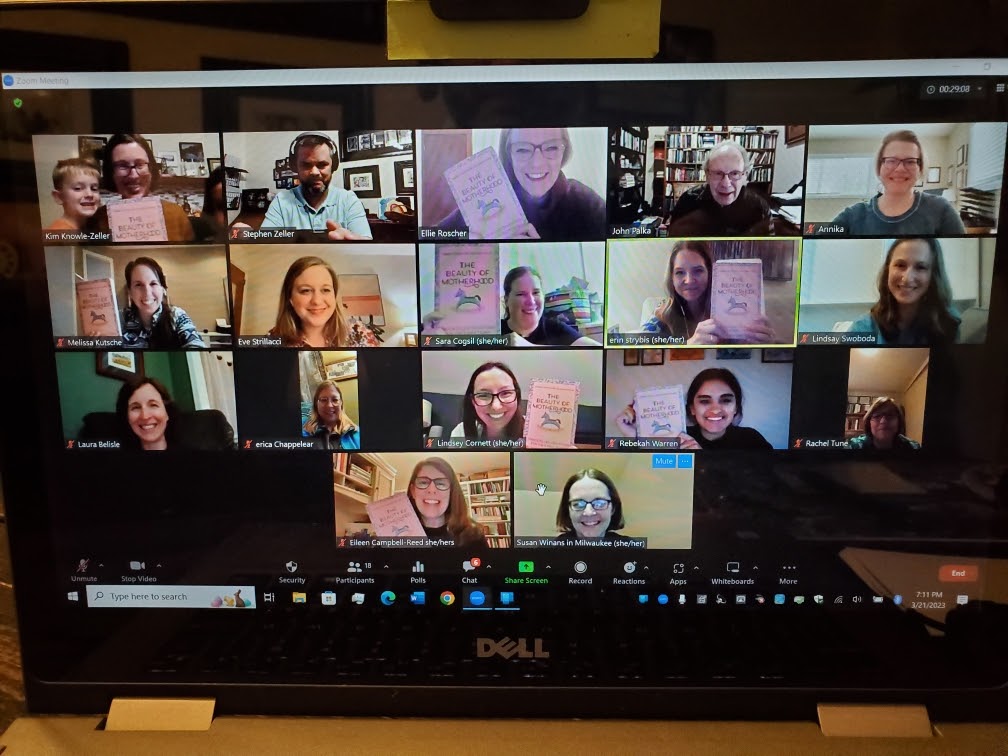
On March 28, the evening our book launched, Kim and I gathered for a virtual launch party on Zoom, hosted by our friend, author Ellie Roscher. We shared two readings from The Beauty of Motherhood, then joined in conversation with Ellie about faith, our writing process and takeaways from writing this book. I found myself overwhelmed with gratitude for my coauthor Kim and for the small band of friends that joined us to celebrate. Our host’s warm presence made it a meaningful evening for all.
Local Launch Event
The morning of my local book launch, I stood in my church sanctuary, clutching my phone as messages trickled in. Two friends’ kids were sick. Another two were tied up with other commitments. A pit formed in my stomach. Would anyone (other than my family) show up? Would I be able to speak eloquently?
Little by little, the pews filled — with friends, fellow church members and my family. Soon we had a small crowd, but I couldn’t shake the tightness that had lodged itself in my gut. I felt the fright you feel at the top of a climbing wall, just before you release your grip and rappel to the earth. I worried: What if I crash?
Then I surveyed the scene. I saw my pastors, and the kind souls who came to hear me read. You are safe, their eyes said. It’s okay to let go.
I stepped into the center of the sanctuary. I felt the heft of my stories in my hands. It was time to release these stories, trusting they would land with their intended readers. I let the Spirit lead me until I was touching solid ground.

As I read, which was a new experience for me, my heart began to calm. I reveled in the audience’s bursts of laughter and audible sighs. When their final applause washed over me, I felt a deep sense of peace. They convinced me that the countless hours of work and vulnerability Kim and I poured into this devotional are indeed serving a greater purpose — to connect others with God’s abundant love.

After my reading, I spent time on stage immersed in conversation with my pastor. We discussed what it means to raise children in faith and the challenges we experience along the way. We reflected on how to model forgiveness for our children, and how to be curious together about our faith questions and doubts. Afterwards, I signed copies of books for those present. By the end of our gathering, my cheeks hurt from smiling. At each point during this special day, I had the sense I was being held by my friends, my family and God.
Barnes & Noble Signing

The weekend before Mother’s Day, my local Barnes & Noble hosted me for a book signing. I had a table near the entrance to greet and connect with new readers who were looking for gifts. A handful decided a signed copy of The Beauty of Motherhood would be a good option for their loved ones, which delighted me.
In addition, many of the friends who couldn’t make it to my launch event popped in to have their books signed, which brought tears of joy to my eyes. While I would much rather stay in my writer’s cave than be out in public, this event moved me and reminded me that connecting with readers is more fun than scary. The experience was both humbling and holy.
Connecting with Moms’ Groups

In April and May, I had opportunities to connect with local parents’ groups both online and in person to offer selected readings from The Beauty of Motherhood and facilitate group discussion. There’s nothing I love more than being in conversation with others about books, and to hear readers respond to the prompts we included with our devotions was such a treat.
Although I entered these group settings as a discussion facilitator, I found myself comforted and convicted by the stories of those who joined us. These gatherings have been powerful, meaningful and Spirit-led. I pray that all attendees walked away nourished by the gifts of community.
If you have a parents’/moms’ group in your church, school or neighborhood that might benefit from a book study of The Beauty of Motherhood, I’d love to hear from you! Use my contact form to be in touch with me via email.
What’s next
Summer’s right around the corner, which means I’m leaning into rest and time with my two boys while I recover from the mental and spiritual challenges of book marketing.
Later this year I have some events in the works, including another local book study and an upcoming women’s conference at which Kim and I will be workshop facilitators. If you’d like to be the first to know about my upcoming events, you can sign up for my monthly newsletter, Nourish.
I’m deeply grateful for each and every act of support readers have offered during book launch season. While my coauthor Kim and I share a byline for The Beauty of Motherhood, we know it takes a village to birth a book. Thank you for being part of ours!
Why I let him nap in my arms…again
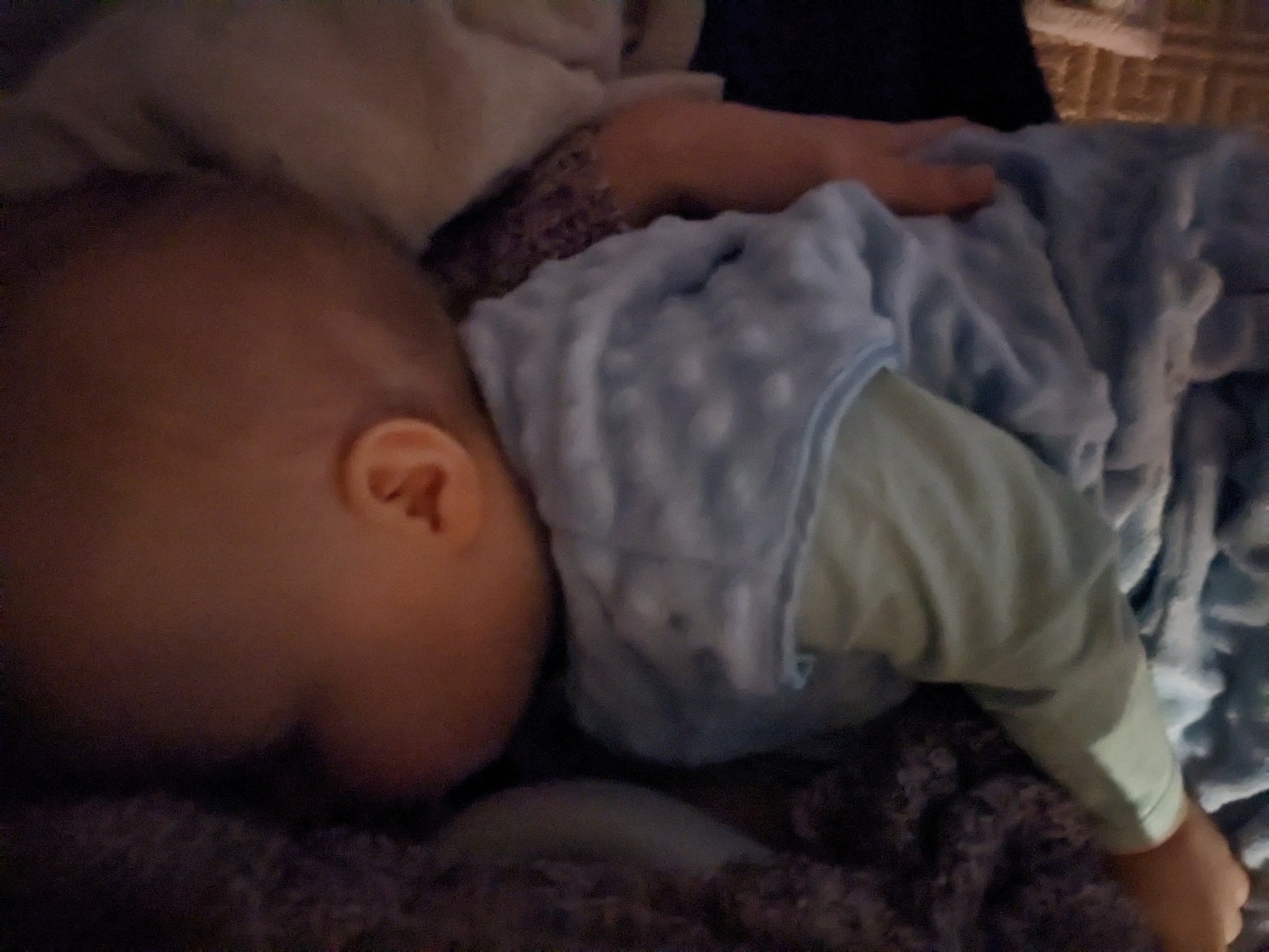
Because he woke up early from his nap.
Because he was calling “Ma-ma! Ma-ma!”
Because when I collected him from the crib,
he nestled his head against my shoulder.
Because he needed more sleep.
Because I needed him, too.
Because I could *not* answer another email or tidy another toy or wash another dish.
Because being his safe space is more important to me than being productive.
Because even though sleep experts say to avoid “bad habits,” they can’t deny that nursing a baby to sleep is positively delicious.
Because he just turned one, and his babyhood is slipping away like fine sand.
Because an hour ago, he stuck his hand in the toilet, then dumped out the dog’s water bowl and wailed when I changed his diaper and I just needed to recall his sweetness.
Because here, in the curve of my arms,
he looks like an angel.
Because he is likely my last child.
Because one day I’ll tell him,
“When you were a baby, your favorite
place to fall asleep was in my arms.”
Because he’s not ready to give this up.
Because I can’t let this go — not yet.
Because someday I’ll look back on this season —
when the house was a mess
and I wore tiredness like a uniform
and my baby stuck to me like my shadow — and realize all of it was magic.
If you liked this post, you may enjoy my book, The Beauty of Motherhood, releasing March 21. Preorders are so important; I’d be honored if you purchased this devotional for yourself or a new mama you love. For more information, visit my book page.
 Erin Strybis