I stand at the edge of the river, gazing out at the horizon. Azure sky and mountains and wind and sunlight surround me, threaten to engulf me. Alone on a bridge in central Washington, I listen. Rapids rush beneath me. A smattering of leaves flutter down from a distant tree.
I wonder what it’s like to live someplace where the earth feels so alive it’s singing to you.
Earlier this year I stopped going to church for a season. Not because I don’t love my church or because my church hurt me. On the contrary, I love my church community. Deeply. I stopped going because I couldn’t hear God speaking to me there and I couldn’t bear to take communion while feeling like a hypocrite.
The truth is, I was angry at God. Everyone is carrying something, and for two years, I’ve carried the weight of family illness. I questioned. I doubted. I buried myself in work. Anything to avoid the deafening silence of prayers unanswered.
I have spent 10 years working in ministry, telling stories of God’s creative and redeeming work. Being a professional Christian typically does not afford time or space for a faith crisis, you keep working through it all. You cannot stop.
But when the opportunity to press pause, to take a sabbatical this fall became available to me, I applied, knowing how much I needed it. I needed to step away. For my family. For my heart.
Today I’ll take a boat to Holden Village, a Lutheran retreat center in the mountains. I’m going there to rest. To listen. To worship. To write.
On the bridge: This song, it’s not so much a voice as it is a feeling. Warmth. Joy. Presence. Comfort. I let out a sigh. How long have I been holding my breath? And I consider: Perhaps God also speaks to us in our darkest moments. In the silence. In the doubt.
He just wanted banana bread. Eager to please and to get us out of the house, I obliged.
We sat side by side in a bustling Starbucks, stealing a moment together before work and school. My son slurped apple juice and nibbled at his bread. I sipped my coffee, barely tasting it. Eyes glued to my phone, I scrolled and scrolled for answers I knew I wouldn’t find.
Irritated, I looked up. That’s when I noticed my son staring down every visitor walking in the door. Morning sunlight framed his sweet face and curious blue-green eyes.
Before I could smile, the door swung closed and I took a breath. What was I thinking bringing him here? It’s not safe here. It’s not safe anywhere anymore.
Last Saturday somebody strode through the doors of a Walmart, gun loaded with hate. A Mommy and Daddy died shielding their baby from his bullets.
A day later, news broke of a second shooting closer to home, then word of more violence in our city. Blood-soaked, lifeless bodies on linoleum tiles and hot pavement. Lives cut short. Hundreds of families shattered forever. With trembling hands, I balled up our trash and swiftly rose.
“Jack, we’re leaving now,” I announced.
“Uppy, uppy!” he pleaded. And even though he’s perfectly old enough to walk himself to the car, I didn’t hesitate. I hoisted him in my arms, busting outside.
I punched the start button on the car. Elmo’s upbeat alphabet rap blared through the car stereo, but I couldn’t stop thinking of Brian Bilston’s poem “America is a Gun”:
England is a cup of tea.
France, a wheel of ripened brie.
Greece, a short, squat olive tree.
America is a gun.
I gripped the wheel hard. I don’t know how to tell him why we rushed out or why, a week later I won’t bat an eyelash when I bring him with me to get groceries.
America is a gun. The sentence tumbled around my head as I turned into the Montessori parking lot. The need to offer my son an explanation pressed on me and I took my time unloading him from the car.
More than anything, I want us to live in a place that reflects the values he’s learning in school and at home: That there is more than enough for us all, if we share. That everyone deserves to be treated with love and kindness. That we all have a right to live — without fear. How can I tell my son those ideals have been compromised by our nation’s leaders? And fellow citizens?
I don’t want to shield him from the violence of the world, but the need to shield him from crippling worry feels more right.
After lacing up his shoes, this is what I did: I bent over and kissed my son’s cheek, twice. Then I repeated our weekday morning benediction, “I love you buddy! Have a good day!” before he entered his classroom. And, with a prayer for peace pounding in my tender heart, I opened the door and stepped out into the daylight.
“Wait, you still have to stay in his room at bedtime?” she asked, a hint of pity in her voice. We sharing stories and dinner in my home and my least favorite parenting topic had arisen.
“Yeah,” I said sheepishly. “With all his ear infections and our failed attempts at sleep training, he just never got the hang of falling asleep on his own.” I looked down and cut at my lasagna. “Honestly, it’s easier this way.”
“Oh honey, that’s so hard,” she said. It was definitely pity. “It sounds like you need some time for you.”
There was so much more to the story – how much better his sleep was compared to year one, how most nights I dreaded our exhaustive routine but occasionally I savored it — but I couldn’t bring myself to tell it. I took a bite and nodded, searching for how to change the subject.
“So, tell me about your new project…?” And with that, I steered our conversation forward.
//
There’s something I need to tell you: I’m a bit of an overachiever. I took honors classes from grade school through college. I racked up extracurriculars — choir, cross country, steel drum band, student council — like girl scout badges. For the majority of my short life, I measured my life in grade point averages and activities mastered. The higher, the better.
Naturally, when I achieved my goal of getting pregnant, I began to research every aspect of motherhood. I dove into Expecting Better and my app from The Bump, then lost myself in the mesmerizing world of Mom Influencers. Square after Insta-square they lined up proof of motherly excellence: heart-melting images of swaddled newborns, perfectly styled nurseries and stunning family photo sessions caught at the golden hour.
I wanted that shiny life. Honestly, I still want it, even though I now know those images don’t tell the whole story. Not the back-breaking pain of labor and sleep deprivation or the piercing fear of your child dying. Nor can they fully convey the heart-bursting joy of seeing your child’s first radiant smile or lulling him to sleep with your favorite lullaby, the one dad used to sing at bedtime until you outgrew it.
In 2019, it’s easy to engage in performative parenting — documenting our children’s wins online in exchange for “likes” and a little boost of satisfaction. Raising kids can be so thankless sometimes, and it feels good to be validated. But motherhood is not a race to be won or a course to be aced or a song to be mastered. Motherhood, I’m finding, is terribly difficult to measure. Deep down I know this, but I go ahead and try anyway.
//
“Please eat your peas,” I said, pointing to my son’s plate.
“I don’t want to!” he responded, edging his plate toward mine.
“Please honey,” I pleaded, nudging it back. I could have written this scene a plethora of ways, all varieties of vegetables and moods and tactics, all leading to the same, stubborn answer:
“No!” he shouted, crossing his arms. We sat at the table in silence, glaring at one another. In his eyes I saw his characteristic spark of defiance. Oh please not another tantrum…
“Fine,” I said icily, yanking the plate away. “Let’s get you cleaned up to play.”
I’ve lost count of how many times I’ve tried to push healthy food, how many times I’ve thrown up my hands and accepted my son will eat a medley of snacks for dinner.
At the next meal, I’d try again, hoping this time the broccoli or fish or whatever I was pushing would stick. Some days it worked; most days it didn’t. I didn’t think I was doing such a bad job because I’d heard from moms in my circle that I’m not alone in this struggle. Then I got this text from my husband.
Him: Jack’s underweight
Me: Wait…what
Me: By how much?
Me: What did the doctor say
Him: I don’t know but he is in like the 16th percentile or something
Me: Oh God
Him: She kept drilling me about what he eats and drinks
The revelation brought me to my knees — I wasn’t feeding our son the right food. I wasn’t feeding him enough. I wasn’t . . . enough.
This wasn’t the first time I’d felt like I was falling behind as a mama.
Once my son’s teacher reported that he’d been tripping and falling down too much at his Montessori school and maybe he should get involved in some sort of physical activity? That made me feel physically ill. Or there was the time our expensive sleep consultant told me I’d nursed my son for too long, implying that I’d “ruined” his ability to soothe himself to sleep. Gut punch. And, yes, there was that dinner table conversation about bedtime that left me swimming in a sea of self-doubt.
//
Her voice is sharp and judgy; she’s constantly criticizing me:
You shouldn’t have yelled at him that way.
You should have faxed in that medical form last week.
You shouldn’t be on your phone right now — play with him.
You should have been there for his big milestone, instead of at work.
More than any other marker, not the shiny moms on the internet or the ones I know IRL, my inner critic likes to remind me of all the ways I’m not measuring up as a mama. Ever the overachiever, she grades me against her great expectations.
My mom stayed home with my brother and me when we were little. I don’t remember the years well, but I do know she was an excellent mother — kind, patient, generous, slow to anger. Still is. I wish I could give my son what I had growing up, not what I’m actually giving him. Fits and spurts of weekday parenting plus long weekends doesn’t feel like enough to me. Often I feel I cannot keep up with motherhood and my career — the pace, the demands of each is too intense to do either very well.
So how do I address this nagging feeling I’m not measuring up? One option might be to ignore or reject it. Good in theory, but harder to execute. Another option might be to make peace with my inner critic, and maybe even give her a little compassion. It’s only human nature to compare yourselves to others, so why not just accept it? Plus swapping stories with fellow mamas has lent me some fantastic tools and tricks for navigating the grueling early years.
An additional way might be to consider what I’m measuring when it comes to motherhood. Yes, the importance of nutrition and sleep and education cannot be downplayed. (If you’re wondering: My husband and I did make a plan for our son to get his weight back on track. And bedtime’s been getting better.) But what if there was something else I could use as a benchmark?
In my work as a freelance parenting writer, I’ve found one theory of child development that keeps turning up, no matter if my story is about teaching your child to tidy up or to inherit your values. That common thread is: What we model, our children inherit. Children soak up the words we speak and the actions we take and reflect them back to us like a mirror.
Could it really be quite that hard and that simple? On the one hand, this is great news. I hope my son mirrors my commitment to relationships and health and creativity. On the other, I don’t know if I can live up to that sort of pressure. My flaws — my pride, my people-pleasing, my workaholism, my perfectionism, to name a few — are not what I want to pass on to him.
Thankfully, to borrow from a Lutheran pastor I heard preach last summer, “There’s grace for that.”
There’s grace for the mom who yells. For the striving mom who always feels like she’s failing. For the mom who’s angry and overwhelmed and in need of a little validation. For the mom who invests so much in her children she forgets herself. For the mom who misses her freedom and wishes she could be more present. (I’ve been all these moms and more.) The good news?
Graces lift us up when we inevitably stumble.
//
Last week my son and I were in his playroom, sitting thigh to thigh in his mini Pottery Barn chair, chewing on a couple of chocolate chip cookies. Summer sunlight was streaming through the windows, and, as we chomped away, I relished the cookie’s sweetness. Out of the blue he remarked, “Mommy, sometimes I get mad.”
The simple expression stopped me mid-chew. Minutes ago he’d thrown not one but two tantrums when I explained that we could not have a popsicle and a cookie right now, we had to choose just one for dessert. This unexpected utterance made me think maybe all those episodes of Daniel Tiger and conversations about forgiveness were starting to sink in.
“I know buddy,” I answered, rubbing his back with one arm. “That’s normal.”
“Sorry Mommy,” he said, rising to wrap his arms around me, crumbs tumbling off his lips and fingers. “I love you Mommy!”
My eyes smarted with tears. I sure know I stumble often as a mama, but if my son can hold onto this sweetness, I will consider my work excellent.
“Oh honey, I understand,” I said, kissing his cheek and pulling him in tighter. “I love you too.”
If I’m going to measure anything, God, let it be love.
I wrote this post as part of a blog hop with Exhale — an online community of women pursuing creativity alongside motherhood led by the women of Coffee + Crumbs. Click here to read the next post in this series “Measuring Up.” Image credit: Phoenix Feathers Calligraphy
This is your Monday reminder that you are not defined by your number of followers.
You are not defined by a number on a scale.
You are not defined by a number in your bank account.
You are not defined by the number of checks on your to-do list.
The sum of these numbers is how the world measures worth — numbers don’t define you.
You are not your career, your side hustle, your workout or your zip code.
You are not your accolades, your relationship status, your diet, your voting record.
You are not your skin, your hair, the clothes you wear, your tidy home, your Insta-squares.
You are a soul, longing for connection.
You are a beloved, gifted creation.
You are light, laughter, mercy, sweetness.
You are the author of a story that’s still unfolding.
They say keep chasing, striving, leveling up — when you achieve it, you will be happy.
They say you are not enough.
I say they’re wrong.
You cannot earn love; you already have it.
You cannot avoid pain by being perfect.
You are flawed, afraid and a little tender.
You are fearfully and wonderfully made.
Just as you are.
Self-love isn’t mediocrity — it’s a catalyst. Self-love isn’t selfish — it’s a revolution. Only when we free ourselves from the lies culture feeds us about who deserves love can we practice radical empathy for ourselves and others.
Are you brave enough to embrace it all — your shortcomings and strengths — and call it worthy?
I’m halfway through Ross Gay’s essay collection, The Book of Delights, which has enlightened my gratitude practice. My practice, which I call “evening pages,” is a spin on creative guru Julia Cameron’s morning pages—three long-hand pages on any topic you want, done first thing in the morning. Instead of every morning, I do this at night to unwind.
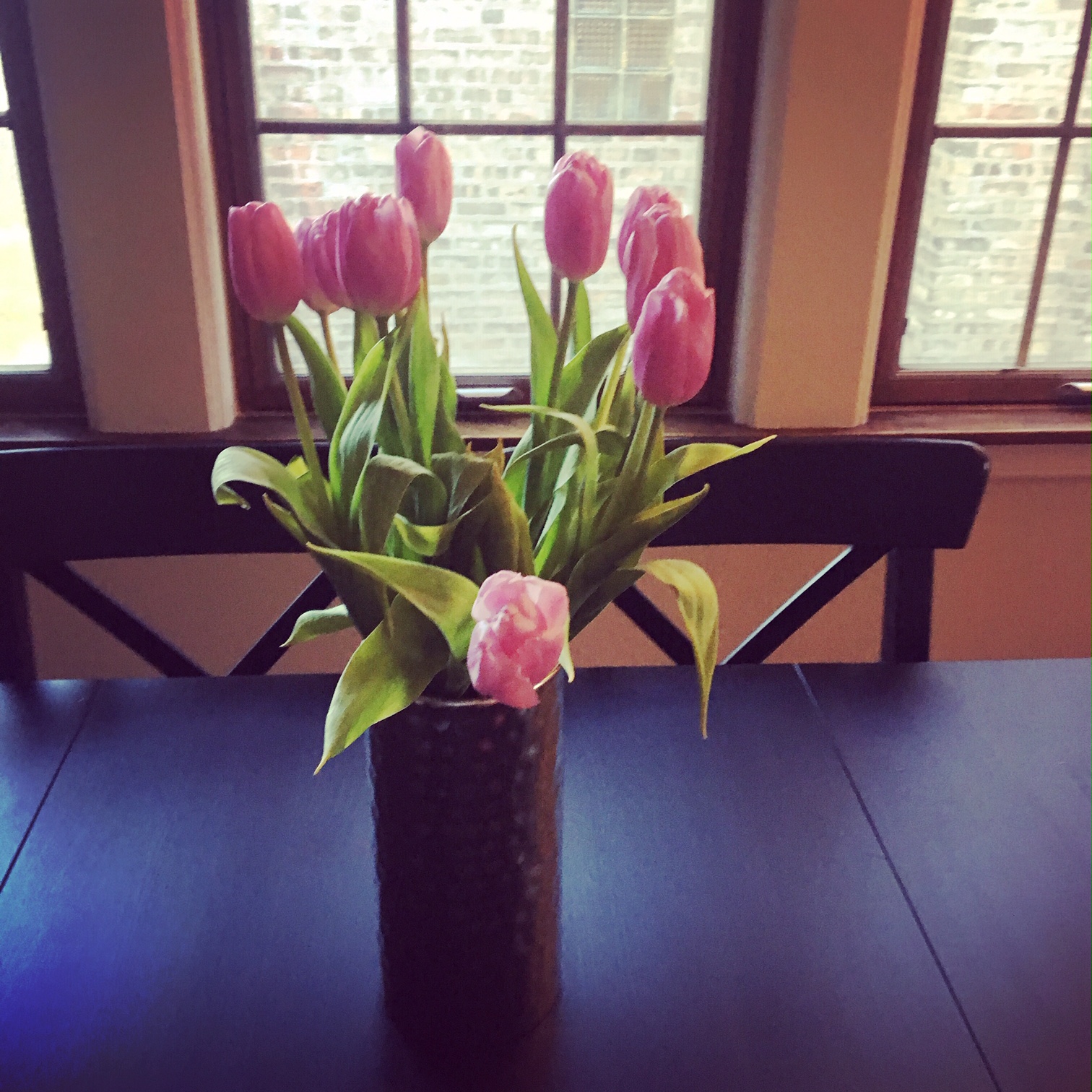
Often as I write I find myself listing my delights: singing “Zip-a-Dee-Doo-Dah” to my giggly toddler, the first zesty spoonful of homemade marinara sauce, finishing a juicy book, starting a new one (or three), my dog curled up in my lap, 40 degree weather, budding pink tulips (#thegoodlist, ala Erin Loechner).
Gay, a poet, is teaching me there’s room to revel in small wonders while holding pain.
This isn’t a popular hashtag, but there’s a bad list too. You have one? Here, I’ll go first: when churning thoughts lead to sleepless nights, when doubt comes knocking, jealously too, when I’m tired.tired.tired of all the guns and hate and suffering in this world, when my heart’s so starved for good news no amount of praying or Scripture satisfies the craving.
In essay 14, Gay celebrates the tactile pleasure of a cakey, vegan donut while pondering the heavy reality of life and death, joy and sorrow. “It astonishes me sometimes—no, often—how every person I get to know—everyone, regardless of everything, by which I mean everything lives with profound personal sorrow,” he writes. “Is sorrow the true wild? And if it is—and if we join them—your wild to mine—what’s that?”
This idea, that we can carry each other through despair, softens my hunger pangs.
During Lent, the Christian church joins together in repentance while we march, with shaking hands, toward the cross. We mark our heads with ash, a symbol life is always on the cusp of slipping from our fingers. The older I get, the more I notice myself waffling between doubting Thomas and a religious zealot, desperate for the Easter story to be true.
Just when I think I’ve lost my way, hope springs forth in a neighbor’s kindness, in green shoots pushing up from the hardened earth, in the promise God’s making everything new.
If only I could get consistent with publishing, then I’d grow my platform. If only I could be more patient with my toddler, then I’d be a better parent. If only I could get my work inbox in order, then I’d be ahead at the office.
If only, if only, if only . . . Daily I find myself battling this notion I’m running behind—on deadlines, at home, in my career. On the one hand, that may be true. I scrolled my phone when I woke up instead of diving into my current writing project. I rushed my toddler this morning, likely causing his major meltdown. I showed up at the office after 9 a.m. to a disorganized inbox.
I’d like to think I’ve healed from my perfectionistic tendencies, but I guess coping with perfectionism is more like battling addiction. You can never really be over it. I have this deep drive to be “perfect,” but I’m not even sure why it exists.
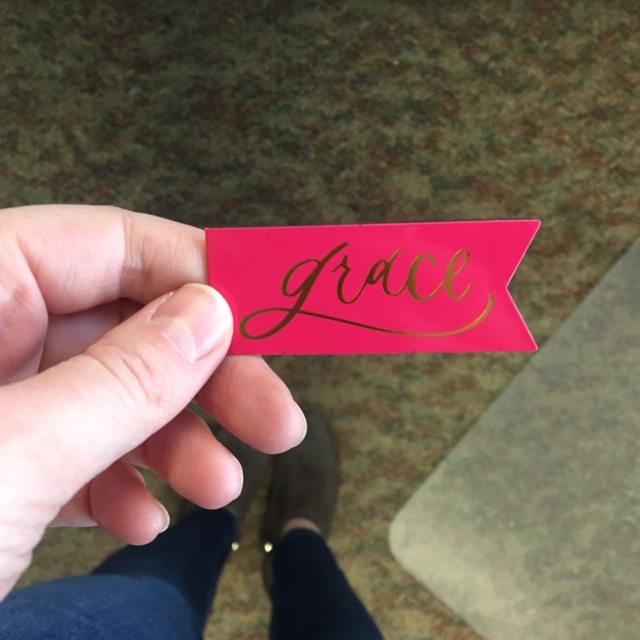
A couple weeks ago I bought this “grace” page marker for my planner. I thought it would be a good reminder for me—queen of to-do lists, good intentions and hidden little messes—that God’s grace surrounds and permeates my life, even when I can’t see it.
Here’s the gospel truth: The idealized me, the version I’m striving so hard to be, isn’t the me God sees and loves. God loves me in my self-absorbed, hustling, sinful mess. God loves me in my goodness too.
Thinking back, my morning was blessed—I had a productive writing session, I savored extra dog and toddler snuggles and relished returning to worthwhile work after a long weekend.
If only I could see all this outright, but so often lingering #perfectionism blurs my judgment. Luckily, there’s grace for that. God’s unconditional love disrupts my paradigm and grounds me in my inherent worthiness. I need that reminder daily. I shared this today in case you need it too.
You can build a wall with words; brick by brick, stack up fear and hate. Sir, the wall you seek? It’s already standing.
Here is the ugly truth: this nation was built through genocide, on the backs of slaves, upon the false principle whiteness reigns supreme.
Here is another truth: my family is no different than those at the border. I am a descendant of immigrants. Brazened by hope, they crossed the Atlantic to start anew and blessed me with a better future.
I want to spend my life tearing down walls of hate with words of love. I raise my voice because my faith demands it.
Listen. Our brothers and sisters wait at the door. Will we show them heartlessness or compassion?
Two years ago, I sobbed when America didn’t elect her.
And I continue to lament the way his presidency’s built walls in our nation. His words and actions have fostered hate for those who look or worship or love or vote differently than us; cruelty at our borders; distrust of the truth — of journalists and scientists. On multiple occasions, he’s failed to denounce the evils of white supremacy and gun violence.
Today, I am hopeful: a wave of voters showed up and lifted their voices across America. They voted for their brothers and sisters in need, for the earth, for peace, for gun sense, for kindness and compassion. They elected new leaders, many women and people of color. Together, we made history.
We are stronger as a nation when our leaders reflect the great diversity of our country. Don’t stop now. Let’s continue lifting our voices and showing up for each other in a wave of love.
When the ones you love the hardest are suffering and you’re unable to stop it, it’s isolating and terrifying. The pain is sharp and heavy, almost unbearable. I felt like that yesterday.
But God showed up for me in a gifted bag of donuts from a new Cambodian friend; in holy conversation with an old friend in which I felt seen, heard and loved; and in this simple note stashed in my bag by a stranger: You are loved. The message arrived just when I needed it. It gave me hope.
What I’m beginning to realize is this: God does not abandon us in dark moments. God provides people and places and signs of love every day, we just have to notice them. God loves *you* dearly. And God’s love changes everything.
Lately it feels like everything is scrambling for my attention. Unread emails. Missed text messages. Facebook notifications. Shows to watch. Articles to read. New podcasts to play. The pull of infinite content, waiting to be consumed.
Do you feel it too?
We have work to do, bills to pay, children to raise, relationships to nourish, bodies to feed/exercise/clothe/rest. We belong to faith communities and organizations and gyms. We have second jobs and side hustles and volunteer gigs. Lunch dates, dinner dates, brunch with friends. Never stopping. Never slowing. Go. Go. Go.
Our lives are full. Our attention—limited. We feel overwhelmed.
I have this theory about attention. It’s kind of like water from a well. The well is deep and expansive, filled with cool, refreshing water we can share with others. On good days, we share water generously and have plenty left to nourish myself. Sometimes we hoard water, and we become bloated. Sometimes we waste water and only have a little left for ourselves. If we’re not careful, the well can run dry.
In this moment in time, I believe we’re all thirsty for something better. We are all parched.
So what do we do? How do we fill up our well?
First, we need to examine what true attention really is. Ever been in a really good conversation with someone where it felt as though you were really seen and heard? They allowed you to talk as much as you needed without feeling ashamed or embarrassed, nodded their head at all the right times and asked engaging questions. Didn’t that just make you feel warm, cozy and joyful?
My late grandpa was a lot like that–an attentive, compassionate listener. If he engaged you in conversation–and chances are certain that if you looked like you needed company he would–he’d give you his undivided attention, nodding his head and asking questions.
My grandma told me recently that often when new members of their congregation, Christ the King Lutheran Church, were asked why they joined, most had the same answer. (No, it wasn’t Jesus.) They said they came because of Richard (my grandpa). Imagine that!
I think one of the joys of my grandpa’s life was learning about others and encouraging them. He was warm, kind and generous to everyone he met.
There are a lot of things to pay attention to these days–but certainly paying attention to people seems like a good place to start.
Whatever it is that clamors for your attention, consider this: Paying attention is an act of love.
That’s what the award-winning film Lady Bird asserts in this exchange between Christine (Lady Bird), a senior at a Catholic high school, and her teacher, Sister Sarah Joan:
Sister Sarah Joan: You clearly love Sacramento.
Christine ‘Lady Bird’ McPherson: I do?
Sister Sarah Joan: You write about Sacramento so affectionately and with such care.
Christine ‘Lady Bird’ McPherson: I was just describing it.
Sister Sarah Joan: Well it comes across as love.
Christine ‘Lady Bird’ McPherson: Sure, I guess I pay attention.
Sister Sarah Joan: Don’t you think maybe they are the same thing? Love and attention?
Amen, sister!
This scene is wedged within tense moments between Lady Bird and her mother, who relentlessly criticizes her. We see her mother’s behavior throughout the film and notice it is a demonstration–though a harmful one–of her deep love for her only daughter. That difficult relationship comes to a head when Lady Bird’s mother finds out her daughter applied to and was accepted accepted into a college outside of Sacramento she was forbidden to attend. As punishment her mother stops talking with Lady Bird and ignores her completely.
Lady Bird’s mother vengefully rescinds her attention, her love, from her daughter and gives her the silent treatment. It is painful for Lady Bird and painful to watch.
An aside: Ever given someone the silent treatment? Ironically, this ‘punishment’ takes an incredible amount of attention to pull off–and for Lady Bird’s mother to do so for a long time indicates the depth of her disappointment and love for her daughter.
Although we never see Lady Bird and her mother reconcile, there is a moment at the end of the film when Lady Bird calls her mother and pours out her heart to her over voicemail, making me hopeful that they someday will.
I wholeheartedly agree with the writers of Lady Bird: attention is an expression of love. And I’ll add–sometimes, attention is holy.
Ever have a heart-to-heart with someone that leaves you feeling relieved and understood? Ever lock eyes with someone and feel like they saw your soul? Ever receive public or private praise for something you worked hard on—even when you thought no one was noticing? This is holy attention. This is love in action, life-giving and nourishing and focused and pure.
I have a hypothesis about our current technology-ridden context. What if we are all feeling so exhausted and scattered because we’re not being intentional with our attention? What if we’re not using it wisely?
How many of us struggle with the dance of dividing our attention, knowing we have, on occasion, failed in our relationships or commitments or even our self-care simply because we feel as though there isn’t enough time?
Here’s the hard truth: Our attention has limits.
We’re only human after all.
If I do a time audit of my day, what might I find about my attention? I think I would be surprised to find the amount of attention I waste on social media–on my phone–rather than noticing the world around me. I want to spend more time cultivating relationships, including the most important relationships–with God and family and myself.
So how do we start living in away that honors what we really love?
We remember attention is holy.
We understand attention is a gift.
But here’s the secret: there is a way to deepen your reserves of attention. And that means giving that holy attention right back to yourself. Nourishing yourself with water from your well.
Listening to the voice inside of you that declares: THIS is what makes me happy. THIS is what I really want and need to do today.
I have this nagging pain, can you heal it?
I have this burning desire to dance, will you let me?
I am feeling stuck, can you help me get unstuck?
Will you pay attention?
Here is a new definition of self-love for you. It’s not getting a pedicure, taking a bubble bath or winding down with a glass of wine–though any of those things are justifiably nice. Self-love is paying attention to the voice inside you that is wild and free, and really listening to it, and seeking to align your actions with your innermost healthy desires.
When we give ourselves the kind of holy attention we crave from others, imitating the kind of holy attention only God can give us–pure, adoring love–it is easier for us to then share our attention with others.
I think about the way, as a mother and on my good days, I give holy attention to my son. How can I give more of that away to people who matter (and less to social media, to my worries)—including me? How can I spend holy time and attention immersed in prayer?
Notice–without judgment–where you spend your time this week. How can you redirect it so that you are giving holy attention to yourself–and to everyone and thing that matters most to you?







 When the ones you love the hardest are suffering and you’re unable to stop it, it’s isolating and terrifying. The pain is sharp and heavy, almost unbearable. I felt like that yesterday.

 Erin Strybis