First things first, you pack your hiking boots, your books, your laptop and your notebook. Make that two notebooks. Plenty of pens, six pairs of socks, underwear, toothpaste and a toothbrush. Two sweaters, four long-sleeve shirts, four pairs of pants. The readings for your workshop, hot off the printer. Cash you forgot to get cash (you will get that at the airport). You tuck away your fear — fear of dying, fear of heights, fear of rape — in the side pocket, next to your hairbrush. Your unearth your winter hat and gloves, and just in case a pair of snow pants. Add courage alongside your laptop in your carry-on backpack. Make sure you have your chargers. Your suitcase is too heavy; you extract three books.
Last but not least “photo of your family” is on the list and you realize you don’t have an updated one in print. You decide the photos on your phone will suffice. (Note to self: Do *not* lose your phone.) You look at your packing list, most items checked off and a few abandoned (you have a tendency to overpack), and wonder if there is anything else you can take to prepare yourself for the journey. This your first pilgrimage to a destination you’ve dreamed of visiting since you were 20.
You’re traveling solo.
Heading into the dark to meet your airport taxi, you worry that maybe you should have brought your son and husband. You think this as you set your suitcase on the security belt, settle into your window seat, step off the bus in an unfamiliar city.
A day later you’ve arrived. No one knows you (yet), and unpacking your boots, books, laptop and notebooks, you feel the chill of sweat down your spine. You question whether you have the capacity to summon the story inside you. To enter the wilderness on your own.
In the library you find a book of poetry by Christine Valters Paintner. You flip to the middle, her words ring out sharp and strong: “This is a voyage best made alone.” You know what you need to do. You pick up the pen and begin.
I stand at the edge of the river, gazing out at the horizon. Azure sky and mountains and wind and sunlight surround me, threaten to engulf me. Alone on a bridge in central Washington, I listen. Rapids rush beneath me. A smattering of leaves flutter down from a distant tree.
I wonder what it’s like to live someplace where the earth feels so alive it’s singing to you.
Earlier this year I stopped going to church for a season. Not because I don’t love my church or because my church hurt me. On the contrary, I love my church community. Deeply. I stopped going because I couldn’t hear God speaking to me there and I couldn’t bear to take communion while feeling like a hypocrite.
The truth is, I was angry at God. Everyone is carrying something, and for two years, I’ve carried the weight of family illness. I questioned. I doubted. I buried myself in work. Anything to avoid the deafening silence of prayers unanswered.
I have spent 10 years working in ministry, telling stories of God’s creative and redeeming work. Being a professional Christian typically does not afford time or space for a faith crisis, you keep working through it all. You cannot stop.
But when the opportunity to press pause, to take a sabbatical this fall became available to me, I applied, knowing how much I needed it. I needed to step away. For my family. For my heart.
Today I’ll take a boat to Holden Village, a Lutheran retreat center in the mountains. I’m going there to rest. To listen. To worship. To write.
On the bridge: This song, it’s not so much a voice as it is a feeling. Warmth. Joy. Presence. Comfort. I let out a sigh. How long have I been holding my breath? And I consider: Perhaps God also speaks to us in our darkest moments. In the silence. In the doubt.
Sabbatical day 5: “If you need to talk to someone, I can help with that.” Her voice echoes kindness; her brow furrows. “Or I can write a prescription.”
I shift my eyes to avoid her gaze. The examination room is spare and spacious, yet the clean, white walls seem to be closing in.
“I’m OK, it’s just . . . there’s been a lot going on.” I sigh and wipe my eyes. Moments ago, the nurse ticked through her medical history checklist, barely glancing up when I noted my mother’s surgery, my father’s treatments, my traumatic C-section. It was protocol, but it felt like a cruel joke when my doctor went through the same questions again. The second time I deliver the answers, my voice cracks. My doctor notices.
She gently begins to interrogate me. We discuss my husband Jay’s health issues, my trouble sleeping, my mental health. The tears arrive unbidden. This was not the plan at all — I’d come here for a routine appointment, not to rehash two and a half years of family drama.
“Your son is at a great age, you should be enjoying this time!” she goes on. “Your husband is going to be fine. I promise.”
This time, I don’t look away. I believe her. Who I’d began to question, however, is myself. Am I really OK?
//
In June, I’d sketched out the plans for my sabbatical, which was approved for September through November. First, a coverage plan for my job as a content editor: I wrapped up projects and doled out writing assignments. In July, I signed up for a writing class and coaching to hold myself accountable toward my sabbatical goal. In August, I submitted an application for a week-long stay at Holden Village, which I hoped to use as a writing retreat of sorts. Finally, I filed my last stories for the magazine, all whilst wrapping up freelance work.
These details are boring but I share them with you because they show me starring as the thoughtful colleague, the meeter of obligations, the planner of activities and that annoying person you know who derives great satisfaction in checking off to-do list boxes. It is a fact: I take great pride in my work. This is not always a good thing, to be defined by doing.
When I closed my work laptop for the last time in late August, I should have felt relieved. Finally, I had more time to focus on my family, my health and the book idea that was on my heart.
Instead I felt lost.
//
Sabbatical day 9: There’s an orb spider living outside our back sunroom. Her perfect, intricate web stretches from one power line to the other, shimmering in the sun. A couple days ago, Jay and I discovered her first web above our candy apple front door. We brushed it away from this highly trafficked spot and carefully transported her into the bushes. A pang of guilt passed through me after we went inside. At least we didn’t kill her.
The sight of her perched in the new web, dotted with dew drops and a few unlucky bugs, makes my breath catch. I begin to think of the spider as a kindred spirit.
//
I’d hoped to begin my sabbatical with gusto: merrily churning out assignments for my writing class, investigating market research, outlining chapters, spinning stories. All around me people are picking up new rhythms as the school year starts and church programming ramps up. On the cusp of a new beginning, I freeze up.
I sit down and write a few lines, then scratch them out because they sound terrible. I type a paragraph, then delete it. I rack my brain to tap into a memory I hope to use to create a scene. I draw a blank. I know there is something here, but I just can’t access it.
At night, I struggle to sleep. Staring into the fuzzy gray, listening to my son’s sound machine from across the hall — this night it plays a rainstorm — I contemplate my career path, my sense of calling. I’ve spent ten years writing professionally and I can’t even finish a damn essay for this class, I think. All the other writers in this class are better than me. Who was I to want to write a book? Why can’t I just be productive? I feel the weight of my privilege and worry I am wasting this gift of time.
I spend an afternoon in my bath towel, moping. I accompany the dog and my husband (who works from home when he’s not traveling) on afternoon walks. He can see something’s bugging me, so he urges me to join them. Rather than buzzing with energy and new ideas, I arrive at our doorstep listless. At some point I write in my journal a phrase I’d read once before, “The problem with having a breakdown is that you don’t know it while you’re in it.”
My web is gone. Unlike my spider friend, I cannot bring myself to spin a new one.
//
Sabbatical day 13: In the afternoon, I receive test results from my doctor’s office. I listen to the voicemail; it says I need to call back. I dial the number and hold my breath. When I look out the dashboard out across our quiet, treelined street I am thinking of my son, first and foremost. Then I think of my husband. My extended family. My dreams and ambitions. And for the first time in days, I dip my head and pray.
Only after I hang up do I exhale. Only then do I notice fresh tears on my cheeks. Again.
My body is trying to tell me something. That night, after putting my son down, I curl up into bed and pass out. I sleep for 11 hours straight.
//
At some point in the middle of this sabbatical, let’s call it day 22, two important things happen:
First, I pick up the phone and call my best friend. Second, I read Tara Westover’s memoir, Educated.
Holly’s voice immediately helps me relax. I lose myself in our conversation, affirming her ups and downs with her baby daughter, sharing my ups and downs with my precocious preschooler. I rest in our stories. I laugh. When I hit the end call button I feel lighter.
I download Educated onto my Kindle because I think it will help me better understand how to tell my stories and it has been on my to-read list for a while. Within the first chapter, I am hooked. It’s so good I devour it in a day and a half, barely moving from the orange arm chair in our living room, eyes locked on the screen, until I have to pick up my son from school. After his bedtime, I open the book again and dive into Tara’s story, reading into the night. One I finish, sleep comes easy.
The tightly wound ball of stress inside me begins to unravel.
//
There is a scene in Educated where Tara sits in a college classroom listening to a lecture on freedom. Her professor is discussing the concepts of negative liberty and positive liberty. Negative liberty involves freeing oneself from external obstacles and constraints. Positive liberty, however, involves the mind, it is freedom from internal, “irrational fears and beliefs, from addictions, superstitions and all other forms of self-coercion.”
Tara — educated outside of the public school system by fundamentalist parents — struggles to grasp the concept of positive liberty. A friend introduces her to Bob Marley’s song, “Redemption,” and she scratches the lyrics None but ourselves can free our minds into her notebook. It is only later Tara realizes the hold her parents have on her thoughts.
I stop reading. Have I been doing this all of my sabbatical? Holding myself prisoner to my own self-doubt? I had not given myself permission to rest. Nor had I given myself permission to write.
//
Sabbatical day 32: “Mommy, you don’t have your phone,” my son says, munching his toast. I watch the bits of grape jelly and crumbs stuck to his lips and smile.
“That’s right, honey, I’m just here to spend time with you,” I answer, taking a sip of my coffee. Hot and creamy, I relish the smell, the way the drink warms my throat and wakes up my mind. Outside our dining room window, the sky is gray and the leaves are beginning to turn outside. Signs of change.
“Mommy can we make butterflies?”
“Of course! Let’s do that before you go to school,” I answer, rising to clear our plates and usher him into the sunroom.
It is now October. I completed my writing course and my final essay didn’t turn out horribly like I thought it would. I’m brainstorming for my book proposal. I slowed down, and I let go of my ambitious expectations. I’m going back to therapy too.
I am rebuilding my web.
At a tiny table in the sunroom, Jack holds a paintbrush with intention, dipping it into the watercolors then swishing it across a butterfly I’d cut for him out of white drawing paper.
“Mommy can you come paint with me?” he asks, turning his face toward me. I stand at the kitchen counter rinsing dishes and think of how many times I turned him down earlier this year in the rush to drop him at school and go to work. I am lucky that today I don’t have to, and I understand what a sweet gift that is. The dishes can wait. This cannot.
So I answer: “Absolutely. Yes.”
…
If you’d like to support my book proposal journey, here are a few ways to help:
Give me feedback! Is there a particular post or article I’ve written that resonated with you? What would you love to read more about? Comment on this post or email me using the contact page on this blog.
Subscribe to this blog and follow me on Instagram to stay in touch. To subscribe, use the sign-up box in the sidebar. Note: I’m taking an Instagram sabbatical for mid-October through November but will be back in December.
Finally, I’d love your prayers or words of encouragement. Thanks, as always, for connecting with me in this space.
They call it the longest, shortest time for a reason, yet every time I glimpse you teetering between boyhood and babyhood, I’m startled.
Like at baby Chloe’s birthday party, while she investigated her first cupcake from her high chair, you begged for a slice of watermelon cake. You licked up the green icing and tore away into the prairie grass faster than I could holler, “Where are you going, buddy?” Light rain streaked down from the gray sky as I watched you from the gazebo thinking surely he’ll stop soon.
But you didn’t.
You just kept running farther and farther into the wild and when you wouldn’t respond to my calls I knew what had to be done, I couldn’t let you keep going so I chased after you myself.
Caught at the edge of the trail, you collapsed into my embrace, eyes shining, mouth stained with frosting, bubbling over with laughter.
(A few days ago, we fell asleep on the bed in the afternoon, your tired toddler body curving into mine. At two and a half years old, you rarely nap with me, not the way you used to when you were so small and sweet. Beforehand you’d refused to go potty, spit out your carrots, threw a tantrum. I woke trapped under the weight of your head in my right armpit, eager to wriggle free. Then I noticed your softened face and the heaviness of your eyelids. You looked angelic. We stayed that way for a while until I slipped out of the bed and let you dream alone.)
In that open field, I’d held you and pleaded, “Jack-Jack, please don’t run away from me like that again. You made Mommy very scared!” Your eyes widened and you nodded your head gravely, like maybe you understood. And we walked hand in hand back through the tall grass back to the gazebo.
Growing up, it seems, is a dance of going out on our own and coming home to rest. We are in the dance right now, you and me, and I’m trying hard to give you the space you need and trust that you’ll know when you need to run back to me. Honestly, on the long, hard days I want to run away from it all. But the truth is, my big-little boy, I need you too. More than you know.
So how about this? We keep up this holy dance, growing apart and together. Two souls in the world — bonded by love.
He just wanted banana bread. Eager to please and to get us out of the house, I obliged.
We sat side by side in a bustling Starbucks, stealing a moment together before work and school. My son slurped apple juice and nibbled at his bread. I sipped my coffee, barely tasting it. Eyes glued to my phone, I scrolled and scrolled for answers I knew I wouldn’t find.
Irritated, I looked up. That’s when I noticed my son staring down every visitor walking in the door. Morning sunlight framed his sweet face and curious blue-green eyes.
Before I could smile, the door swung closed and I took a breath. What was I thinking bringing him here? It’s not safe here. It’s not safe anywhere anymore.
Last Saturday somebody strode through the doors of a Walmart, gun loaded with hate. A Mommy and Daddy died shielding their baby from his bullets.
A day later, news broke of a second shooting closer to home, then word of more violence in our city. Blood-soaked, lifeless bodies on linoleum tiles and hot pavement. Lives cut short. Hundreds of families shattered forever. With trembling hands, I balled up our trash and swiftly rose.
“Jack, we’re leaving now,” I announced.
“Uppy, uppy!” he pleaded. And even though he’s perfectly old enough to walk himself to the car, I didn’t hesitate. I hoisted him in my arms, busting outside.
I punched the start button on the car. Elmo’s upbeat alphabet rap blared through the car stereo, but I couldn’t stop thinking of Brian Bilston’s poem “America is a Gun”:
England is a cup of tea.
France, a wheel of ripened brie.
Greece, a short, squat olive tree.
America is a gun.
I gripped the wheel hard. I don’t know how to tell him why we rushed out or why, a week later I won’t bat an eyelash when I bring him with me to get groceries.
America is a gun. The sentence tumbled around my head as I turned into the Montessori parking lot. The need to offer my son an explanation pressed on me and I took my time unloading him from the car.
More than anything, I want us to live in a place that reflects the values he’s learning in school and at home: That there is more than enough for us all, if we share. That everyone deserves to be treated with love and kindness. That we all have a right to live — without fear. How can I tell my son those ideals have been compromised by our nation’s leaders? And fellow citizens?
I don’t want to shield him from the violence of the world, but the need to shield him from crippling worry feels more right.
After lacing up his shoes, this is what I did: I bent over and kissed my son’s cheek, twice. Then I repeated our weekday morning benediction, “I love you buddy! Have a good day!” before he entered his classroom. And, with a prayer for peace pounding in my tender heart, I opened the door and stepped out into the daylight.
The blare of my alarm snaps me out of a dream. Eyes half-shut, I roll over to silence it, then consider my options. If I get up now, I can write. Maybe. There’s always a chance I could wake my son, a light sleeper, and lose the gift of time. Or I can sink back under the covers and steal another hour of delicious rest. The rhythmic drone of my husband’s snore propels me out of bed. Today I rise.
Step one: Shower. I creep across our creaky floorboards, steal into the bathroom and twist on the squeaky faucet. “Shit,” I mutter, then mouth a prayer: please please please don’t let him wake up, God, just let me have this morning for myself. I’ll be extra good today, I promise. I step in the shower. Scalding water washes over me and baptizes me with possibility. Next: Soap. Rinse. Dry. Dress.
Step two: Coffee, mixed with a dash of cream. I tip-toe into the kitchen, retrieve my mug, the one with a pug on it, then pour the time-brewed coffee into my cup. The aroma of blonde roast fills my lungs and rouses my sleepy mind. I take a sip and savor the just-right temperature. Pure delight.
Step three: Write. I sit at a spare desk in our family’s dining room, coffee on my left and a ticking clock to the right. The time reads 6:20 a.m. I glance at my son’s door. If I’m lucky, I can eke out 40 minutes of writing before he wakes up. I flip open my laptop and begin.
When I became a mother, I needed writing because it allowed to grapple with the giant identity shift happening inside of me. My too-big emotions and broken, achy body overwhelmed me. Psychiatrists call this matrescence, a period in a woman’s life when her body and mind transition to a new role — caretaker. In those early days, I hard and fast, scrawling out ideas before my son summoned me for another feeding.
Bleary-eyed and tired, I wrote sporadically. Yet I kept returning to my journal because it both grounded me and brought me back to life. Etching out my story helped me stitch together the woman I was before giving birth with the woman I was becoming. Sharing it online with others — on my blog and eventually in other publications helped me feel less alone.
Two and a half years later, I sit at my desk, clicking letters and letting my thoughts play out on the screen.
What’s different is that the season of motherhood allows me the semblance of a writing routine. A few days a week, whenever everyone is healthy, I rise early to brainstorm, blog or tackle freelance assignments.
The fact remains: I still need writing like I need water. If I go too long without it, I feel parched.
On the page I belong to no one but myself. There’s no crying to comfort, no milk to fetch, no bottoms to wipe. No texts to return, emails to answer, calls to make. Here I am nothing and I am everything. Line by line, I uncover my identities — wife, mother, sister, daughter, employee, neighbor, friend, believer.
This month I published an essay that brought me to head to head with the crushing weight of my motherly worry. In the midst of a story swimming in fear, my editor noticed a different narrative. She pushed me to resurrect the carefree girl inside of me, the girl I was before I became mother. So I wrote a new scene, and in doing so I discovered this:
“There’s a girl inside of me who loves roller coasters and waterparks and white water rafting, who dreams of visiting Sweden and the Grand Canyon, who’s always up for a little mischief. She runs simply to feel the power of her legs and the wind in her hair. She isn’t plagued by the past or preoccupied with the future. She sees every day as a grand adventure.
She’s brave and afraid. She’s rooted and restless. She boldly pursues what sets her heart on fire. And she’s still here now, aching for a chance to shine. All this time I spent consumed with caring for my son made me forget.”
I stop typing for a moment and sip my coffee. Writing that scene brought me to tears. It reminded me that my identity isn’t just wrapped up in protecting my son. I realized something so important: I need to teach him to live too.
These days, with my son, I’m all in and hands-off. We do more exploring together — last weekend he biked a new path at the forest preserve as my husband and I walked alongside him — and I encourage him to explore on his own. (He’s older and stronger than when I first drafted that essay, so I’ve taken a considerable step back at the playground.) What I’m most grateful for is that writing gifted me with a breakthrough off the page. My prayer for whatever I publish is that my story might someone else with a breakthrough or moment of recognition too.
Fingers to keyboard, pen to paper, I record, reflect, discover. Motherhood unearthed in me a desire to share my stories, but writing, in turn, helps me be a more thoughtful mother.
I hear my son rustling so I only have a moment left at my desk. I save my work and shut my laptop. Tomorrow I will rise again and write — like a mother.
“Wait, you still have to stay in his room at bedtime?” she asked, a hint of pity in her voice. We sharing stories and dinner in my home and my least favorite parenting topic had arisen.
“Yeah,” I said sheepishly. “With all his ear infections and our failed attempts at sleep training, he just never got the hang of falling asleep on his own.” I looked down and cut at my lasagna. “Honestly, it’s easier this way.”
“Oh honey, that’s so hard,” she said. It was definitely pity. “It sounds like you need some time for you.”
There was so much more to the story – how much better his sleep was compared to year one, how most nights I dreaded our exhaustive routine but occasionally I savored it — but I couldn’t bring myself to tell it. I took a bite and nodded, searching for how to change the subject.
“So, tell me about your new project…?” And with that, I steered our conversation forward.
//
There’s something I need to tell you: I’m a bit of an overachiever. I took honors classes from grade school through college. I racked up extracurriculars — choir, cross country, steel drum band, student council — like girl scout badges. For the majority of my short life, I measured my life in grade point averages and activities mastered. The higher, the better.
Naturally, when I achieved my goal of getting pregnant, I began to research every aspect of motherhood. I dove into Expecting Better and my app from The Bump, then lost myself in the mesmerizing world of Mom Influencers. Square after Insta-square they lined up proof of motherly excellence: heart-melting images of swaddled newborns, perfectly styled nurseries and stunning family photo sessions caught at the golden hour.
I wanted that shiny life. Honestly, I still want it, even though I now know those images don’t tell the whole story. Not the back-breaking pain of labor and sleep deprivation or the piercing fear of your child dying. Nor can they fully convey the heart-bursting joy of seeing your child’s first radiant smile or lulling him to sleep with your favorite lullaby, the one dad used to sing at bedtime until you outgrew it.
In 2019, it’s easy to engage in performative parenting — documenting our children’s wins online in exchange for “likes” and a little boost of satisfaction. Raising kids can be so thankless sometimes, and it feels good to be validated. But motherhood is not a race to be won or a course to be aced or a song to be mastered. Motherhood, I’m finding, is terribly difficult to measure. Deep down I know this, but I go ahead and try anyway.
//
“Please eat your peas,” I said, pointing to my son’s plate.
“I don’t want to!” he responded, edging his plate toward mine.
“Please honey,” I pleaded, nudging it back. I could have written this scene a plethora of ways, all varieties of vegetables and moods and tactics, all leading to the same, stubborn answer:
“No!” he shouted, crossing his arms. We sat at the table in silence, glaring at one another. In his eyes I saw his characteristic spark of defiance. Oh please not another tantrum…
“Fine,” I said icily, yanking the plate away. “Let’s get you cleaned up to play.”
I’ve lost count of how many times I’ve tried to push healthy food, how many times I’ve thrown up my hands and accepted my son will eat a medley of snacks for dinner.
At the next meal, I’d try again, hoping this time the broccoli or fish or whatever I was pushing would stick. Some days it worked; most days it didn’t. I didn’t think I was doing such a bad job because I’d heard from moms in my circle that I’m not alone in this struggle. Then I got this text from my husband.
Him: Jack’s underweight
Me: Wait…what
Me: By how much?
Me: What did the doctor say
Him: I don’t know but he is in like the 16th percentile or something
Me: Oh God
Him: She kept drilling me about what he eats and drinks
The revelation brought me to my knees — I wasn’t feeding our son the right food. I wasn’t feeding him enough. I wasn’t . . . enough.
This wasn’t the first time I’d felt like I was falling behind as a mama.
Once my son’s teacher reported that he’d been tripping and falling down too much at his Montessori school and maybe he should get involved in some sort of physical activity? That made me feel physically ill. Or there was the time our expensive sleep consultant told me I’d nursed my son for too long, implying that I’d “ruined” his ability to soothe himself to sleep. Gut punch. And, yes, there was that dinner table conversation about bedtime that left me swimming in a sea of self-doubt.
//
Her voice is sharp and judgy; she’s constantly criticizing me:
You shouldn’t have yelled at him that way.
You should have faxed in that medical form last week.
You shouldn’t be on your phone right now — play with him.
You should have been there for his big milestone, instead of at work.
More than any other marker, not the shiny moms on the internet or the ones I know IRL, my inner critic likes to remind me of all the ways I’m not measuring up as a mama. Ever the overachiever, she grades me against her great expectations.
My mom stayed home with my brother and me when we were little. I don’t remember the years well, but I do know she was an excellent mother — kind, patient, generous, slow to anger. Still is. I wish I could give my son what I had growing up, not what I’m actually giving him. Fits and spurts of weekday parenting plus long weekends doesn’t feel like enough to me. Often I feel I cannot keep up with motherhood and my career — the pace, the demands of each is too intense to do either very well.
So how do I address this nagging feeling I’m not measuring up? One option might be to ignore or reject it. Good in theory, but harder to execute. Another option might be to make peace with my inner critic, and maybe even give her a little compassion. It’s only human nature to compare yourselves to others, so why not just accept it? Plus swapping stories with fellow mamas has lent me some fantastic tools and tricks for navigating the grueling early years.
An additional way might be to consider what I’m measuring when it comes to motherhood. Yes, the importance of nutrition and sleep and education cannot be downplayed. (If you’re wondering: My husband and I did make a plan for our son to get his weight back on track. And bedtime’s been getting better.) But what if there was something else I could use as a benchmark?
In my work as a freelance parenting writer, I’ve found one theory of child development that keeps turning up, no matter if my story is about teaching your child to tidy up or to inherit your values. That common thread is: What we model, our children inherit. Children soak up the words we speak and the actions we take and reflect them back to us like a mirror.
Could it really be quite that hard and that simple? On the one hand, this is great news. I hope my son mirrors my commitment to relationships and health and creativity. On the other, I don’t know if I can live up to that sort of pressure. My flaws — my pride, my people-pleasing, my workaholism, my perfectionism, to name a few — are not what I want to pass on to him.
Thankfully, to borrow from a Lutheran pastor I heard preach last summer, “There’s grace for that.”
There’s grace for the mom who yells. For the striving mom who always feels like she’s failing. For the mom who’s angry and overwhelmed and in need of a little validation. For the mom who invests so much in her children she forgets herself. For the mom who misses her freedom and wishes she could be more present. (I’ve been all these moms and more.) The good news?
Graces lift us up when we inevitably stumble.
//
Last week my son and I were in his playroom, sitting thigh to thigh in his mini Pottery Barn chair, chewing on a couple of chocolate chip cookies. Summer sunlight was streaming through the windows, and, as we chomped away, I relished the cookie’s sweetness. Out of the blue he remarked, “Mommy, sometimes I get mad.”
The simple expression stopped me mid-chew. Minutes ago he’d thrown not one but two tantrums when I explained that we could not have a popsicle and a cookie right now, we had to choose just one for dessert. This unexpected utterance made me think maybe all those episodes of Daniel Tiger and conversations about forgiveness were starting to sink in.
“I know buddy,” I answered, rubbing his back with one arm. “That’s normal.”
“Sorry Mommy,” he said, rising to wrap his arms around me, crumbs tumbling off his lips and fingers. “I love you Mommy!”
My eyes smarted with tears. I sure know I stumble often as a mama, but if my son can hold onto this sweetness, I will consider my work excellent.
“Oh honey, I understand,” I said, kissing his cheek and pulling him in tighter. “I love you too.”
If I’m going to measure anything, God, let it be love.
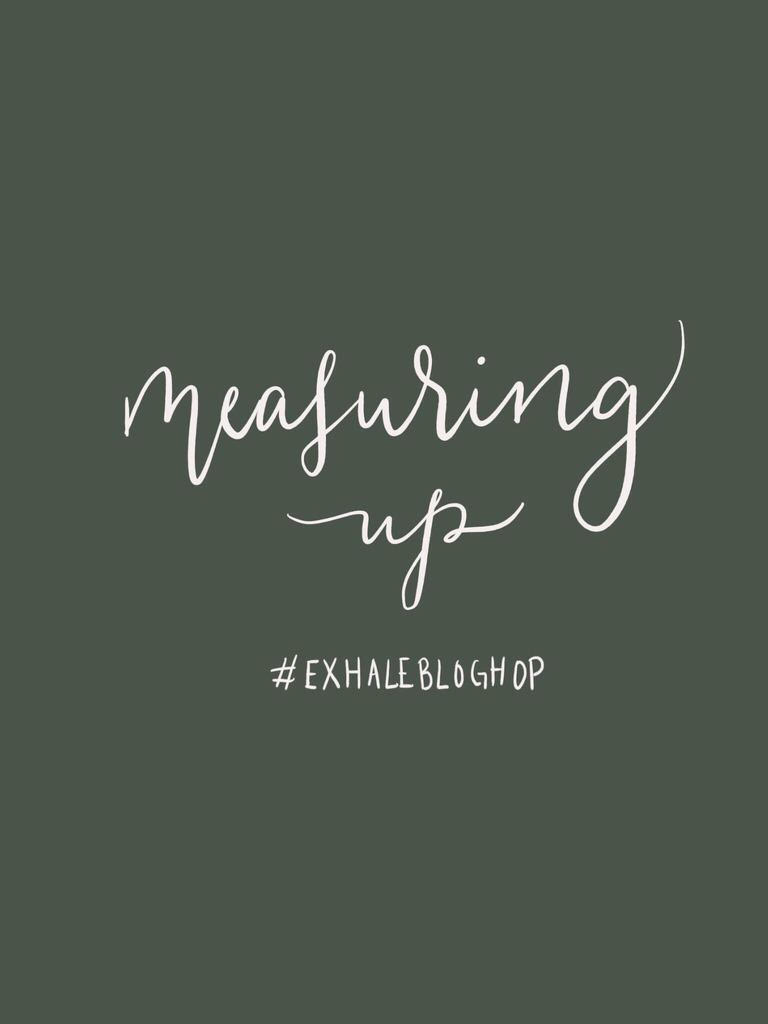
I wrote this post as part of a blog hop with Exhale — an online community of women pursuing creativity alongside motherhood led by the women of Coffee + Crumbs. Click here to read the next post in this series “Measuring Up.” Image credit: Phoenix Feathers Calligraphy
This is your Monday reminder that you are not defined by your number of followers.
You are not defined by a number on a scale.
You are not defined by a number in your bank account.
You are not defined by the number of checks on your to-do list.
The sum of these numbers is how the world measures worth — numbers don’t define you.
You are not your career, your side hustle, your workout or your zip code.
You are not your accolades, your relationship status, your diet, your voting record.
You are not your skin, your hair, the clothes you wear, your tidy home, your Insta-squares.
You are a soul, longing for connection.
You are a beloved, gifted creation.
You are light, laughter, mercy, sweetness.
You are the author of a story that’s still unfolding.
They say keep chasing, striving, leveling up — when you achieve it, you will be happy.
They say you are not enough.
I say they’re wrong.
You cannot earn love; you already have it.
You cannot avoid pain by being perfect.
You are flawed, afraid and a little tender.
You are fearfully and wonderfully made.
Just as you are.
Self-love isn’t mediocrity — it’s a catalyst. Self-love isn’t selfish — it’s a revolution. Only when we free ourselves from the lies culture feeds us about who deserves love can we practice radical empathy for ourselves and others.
Are you brave enough to embrace it all — your shortcomings and strengths — and call it worthy?
I don’t think anyone can fully prepare you for how pivotal it is to become a mother. It’s not that they don’t try. In fact, when you’re expecting, you may find everyone from your great aunt to your coworkers to well-meaning strangers dole out parenting advice. Whether they’re parents or not, many know the searing ache, the bliss of parenthood from their own lives and feel the significance of this new chapter of life of which you’re on the brink.
The journey to parenthood is in and of itself a new chapter, one that for many women and men is full of hopes and heartache. I remember this pain well. Several summers ago, while vacationing with dear friends from college and their families, I stood sobbing in a bathroom stall, wracked with envy. The only childless couple on the trip, my husband and I watched as their beautiful children shared hugs, spread joy and spilled Cheerios.
At the time, we were months into trying for our first child, and it wasn’t going great. For one, after months off birth control, my hormones were all out of wack. Getting pregnant was supposed to be easy, I thought. But now, at 30, it had become clear conceiving a child was much more calculated than others let on. I worried that my body was failing me. I worried we’d waited too long. I worried that my deepest fear — that we wouldn’t be able to have a child — might be true. Over that long weekend, while I observed my friends love on their littles, the thought that dominated my consciousness was, “I want that. Badly.”
Little did I know, I had that. I was actually pregnant with my son, and the hormones were making me tired beyond belief and weepy. The next chapter of my life was already underway.
Flash forward to today. Today is Mother’s Day, and I am actually spending part of it alone in a Starbucks writing. Time alone is a true gift for mothers of small children like myself. It’s what I asked my husband for this holiday, and he graciously granted my request.
Now I am two years and counting into motherhood and feel like an old veteran. I know this sense of security is sketchy at best. Like the time after my son began sleeping through the night consistently, but then began to act — as toddlers often do — in new, headstrong ways. Because I’ve been there before, I know I’ll forever be encountering new challenges and delights. Or, as my coworker and friend Karen says, “Bigger kids, bigger problems.” The constant change of motherhood is exhilarating and unnerving.
But going from expecting to birthing a baby, that change, that new chapter of life is monumental. And not just because your baby is changing. You are too. Those early, grueling months of learning to change diapers and feed a baby on demand are a time of becoming.
In her piece, “The Birth of A Mother,” reproductive psychiatrist Alexandra Sacks says it’s “an identity shift, and one of the most significant psychical and psychological changes a woman will ever experience.” I read this piece weeks into new motherhood, and it brought me so much peace and clarity, I teared up. This year I even had the privilege to interview Sacks for an article I wrote for The Everymom. When we spoke, Sacks said it’s time for us to shed light on this major life transition so that new moms know they’re not alone in their mixed feelings.
I only need look back on my posts from the early days of my son’s life — when caring for a newborn was all consuming, when sleep was a battle, when I felt a love so strong it scared me (still does) — to know the weight of learning to mother.
One of my favorite writers, Shauna Niequist, begins her book, Present Over Perfect naming a period in her adulthood in which she experienced dramatic change as a “sea-change, the journey from one way of living to another.”
And that’s exactly what happens when you become a mother. With a newborn in your arms you toss all your old habits and ways of living out the window and learn to live with and care for another person. Your person. You are no longer alone. You trade freedom for a new way of living. You are a mom! Niequist goes on to say this about her major life transition:
“This is a love story, like all my favorite stories. It’s a story about letting yourself be loved, in all your imperfect, scarred, non-spectacular glory. And it’s about the single most profound life change I’ve yet encountered.”
–Shauna Niequist
I could say the same about my motherhood journey. And I’ll add this: loving my son was the most profound life change I’ve yet encountered. Being his mom is one of my life’s greatest love stories, and it’s still unfolding.
About a month before I gave birth to my son, I started this blog. Since 2008, after I graduated from college and became enamored with blogs, I wanted to have my own. I made a few feeble attempts at blogging over the years but in December 2016 I finally committed. In committing to this blog, I not only committed to writing, I committed to myself, to my story. I was beginning to believe that my words might matter to others.
Then, in January 2017, Jack was born and writing our story has been a tool for me to process, heal, share and reflect on all the highs and lows I’ve encountered throughout motherhood. What a gift to be a mother-writer, what an incredible gift. I look back and see my journey of becoming is written in my heart and on the page — of this blog, my journal, other publications.
In writing through motherhood and sharing it with others, I’ve connected with many other parents — a great blessing. Parents of older children often respond to my stories with comments such as, “Savor it!” and “This time goes so fast.” God, if they only knew just how much I agreed with them.
I’m doing everything in my power to savor this time, even when it’s boring (ever watched three episodes of Umizoomi in a row or cluster-fed a hangry newborn?) or hard to be present (when you have a million deadlines to worry about at work and dirty dishes piled up in the sink). That’s exactly why I’m writing through motherhood — so I can remember it. And give thanks for it. Also: I want others to remember too. Ultimately, when I give birth to a story and offer it up to others, I want it to be a gift that they might use to claim their stories as well.
My friend and writing mentor, author Callie Feyen wrote this about her daughter, “I am a writer because of her not in spite of her.” This resonated deeply with me. When I finally took ownership of my identity as a writer — when I realized I wasn’t just a journalist, I had my own stories to tell — was, consequently, when I became a mother. For that, I am deeply grateful.
In the two plus years since we’ve lived in our new home, I’ve had a lot of design flops. There was the time we tried an online design service that suggested we order a rustic café table for our bay window. Once unboxed and assembled, the table was noticeably too tall for the space—a big disappointment. (It has since been relegated to the basement.) Or the time I hired a talented interior designer for a three-hour consult session to help us pick out furniture. She came and left in one swooping whirlwind of measuring tape and Pinterest boards. Afterwards, I sat alone at our dining room table, staring at her hastily assembled email of suggestions, overwhelmed at the tasks ahead and by the sense I wasn’t really heard.
Our living room’s been a thorn in my side since we moved in, mainly because in my eyes, it’s still “unfinished.” Anyone who knows me well knows I hate a job undone, a task uncrossed off the to-do list, and perhaps that’s what bothers me most of all – not the stuff in the room itself, just the fact we haven’t gotten the mix of items in it right. For a while, I even let this hold me back from inviting over guests.
Despite the fact that I know I should feel differently, I cannot seem to shrug these insecurities about our home. Though I love guests, I’m often afraid to host them.
I would venture to guess I am not alone in this feeling. There is something about opening up our homes that makes us vulnerable. When we host a visitor, we expose our dusty corners, unfinished window treatments, the bin of wrinkled laundry waiting to be folded. We show off the beautiful parts too. Our guests take in our taste in furniture, books, art. They taste our food, see our family photos. Oh, and our peeling baseboards. Our homes have a way of outing us. And what I mean is simply our homes show we are flawed. Our homes show we’re human. This is really hard and good for a recovering perfectionist like me.
But I realized by inviting neighbors into my home — for a planned gathering or, better yet, an impromptu cup of coffee — I practice bravery. Anyway, is a home really a summation of fancy, good-looking stuff that gets posted to Instagram or is it about the people inside of it?
When I think back on all the times I’ve been invited into others’ homes, I rarely recall if they had a fabulous rug or an unfinished kitchen. I think most about the way being in their home made me feel and how I was so grateful to be invited in.
My friend Megan has this thing with inviting people over — for dinner, snacks, Bible study. All in all, she is an excellent hostess. That’s actually how we met. We were strangers and she invited us into her home for a church barbecue. What I love most about Megan’s hospitality is that it feels effortless. When she hosted us at her old apartment in Chicago, her home looked as though real humans lived in it, not like an HGTV space. The food wasn’t always ready, which was good, because I could help cook or while she cooked, we could sit and talk. Whenever I was at her place, I felt so comfortable and loved.
Like Megan, I love making others feel comfortable, but I’ve struggled with this worry that my home wasn’t good enough for them, for one reason or another. But what I found recently when I invited friends over for a book chat is that none of them were worried about my chipped baseboard or retro light fixture. They were interested in my art and the food and sharing stories. As we sipped Pinot Grigio on that rainy, spring afternoon, I realized how silly it was to fixate on all the unfinished stuff when there was so much to be grateful for. For one, I did have a perfectly imperfect, beautiful home. Furthermore, here was this new group of women who were smart, kind and funny. Making friends in your thirties is hard and I’m glad to have met other women in my neighborhood who are eager for connection.
One of my favorite authors, Shauna Niequist, has an incredible book of stories and recipes, Bread and Wine. She recounts well-loved family recipes — her mom’s blueberry crisp, which I make often — and tales of sisterhood built through a monthly cooking club. I devoured the book when I was in my twenties and thought, Gosh, one day when I grow up and move out of the city, I want to have a cooking club like her. I want to have a community like her. Now I’m in my thirties, I live on the city’s edge and I want this more than ever. Who among us doesn’t ache for sacred community?
In Bread and Wine, Shauna talks about the need for tables, gathering people around them, for ditching our worries about appearance and focusing in on what matters — the brave act of opening up to others. She writes that hospitality “is about what happens when we come together, slow down, open our homes, look into one another’s faces, listen to one another’s stories.”
And sure enough, what happened at my recent book chat is what always happens when you put a table between women and when you’re brave enough to slow down, ask hard questions and really listen. We cracked open a book briefly. We sipped wine. We broke bread. And we talked about work and motherhood and infertility and hope and purpose and it was indeed sacred.
Gosh, I couldn’t have been more wrong worrying about the window treatments in my home. All that really mattered was that my neighbors felt at home enough to share their hearts.











 Erin Strybis